
The ABCs of American Fire Marks: N Is for the New England Fire and Marine Insurance Company
History of the New England Fire and Marine Insurance Company of Hartford, Connecticut, 1857 to 1867, Bulau 290, from incorporation to liquidation.
By The Old Underwriter
N is for the New England Fire and Marine Insurance Company, Hartford, Connecticut
1857 – 1867, Bulau 290
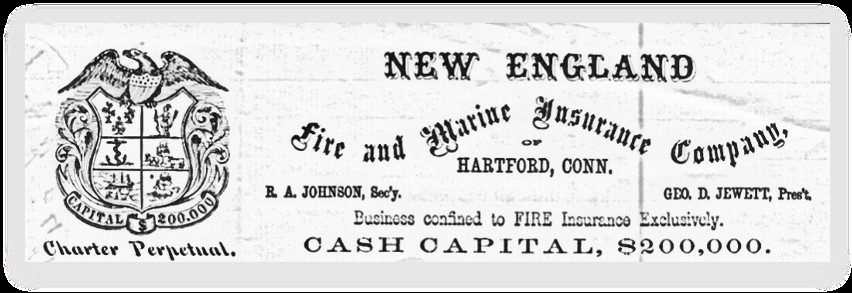
The New England Fire and Marine Insurance Company was incorporated on May 28, 1857 with an authorized capital stock of not less than $200,000, not exceeding $500,000. The $200,000 was quickly subscribed to and paid for in cash.
The company commenced business on November 1, 1858, and by 1859 the company was writing insurance in some of the major cities across the United States. By the early 1860s the New England Fire and Marine had 500 agents who secured considerable business.
Even though the New England Fire and Marine was authorized to write marine insurance and “Marine” was in its name, the company appears to have written only a limited amount of marine busines and by 1861 they advertised that they wrote fire insurance, exclusively. On June 10, 1863, the company’s charter was amended to drop “Marine” and change its name to the New England Fire Insurance Company.
As was common in the period, capital and surplus were combined to show its financial soundness. The most frequent combined amount shown in its advertising was $226,000 with the highest reported at $246,000 for 1862. After years of operation, the company never really showed a growing surplus. Also, in order to appear financially stronger, some of their advertising pointed out that their authorized capital was $500,000. Stressing an authorized capital is actually meaningless to a balance sheet, and somewhat deceptive. At the same time, total losses paid for an annual period were never shown. Its advertising did not show that the company was making a profit or that its underwriting was sound.
By 1865 New York State determined that their capital was impaired, which was made up by assessing the stockholders. Abridged financial statements in newspaper ads across the country did not indicate that there were any problems. It wasn’t until New York State did not renew their license for 1867, again for impaired capital, that there was any indication of a problem.
On June 15, 1867, Connecticut’s Probate Court ordered the company into liquidation and appointed a receiver. The insurance press later reported that the New England Fire Insurance Company was able to pay all its losses.