Revisiting B.240
Questions whether B.240, the eagle plaque Bulau attributed to the Eagle Fire Insurance Company of Boston, is a fire mark, drawing on museum records and auction sales.
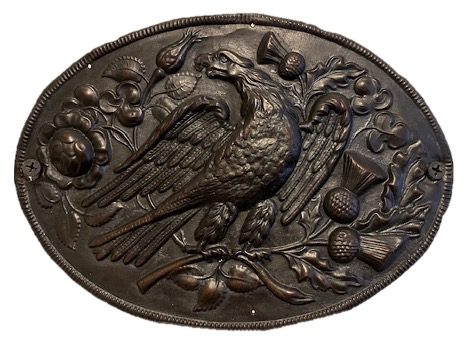
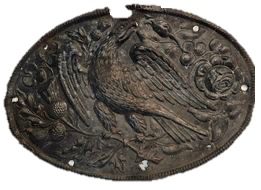
Last year a member sold his collection of fire marks and one of the marks was B.240 or a variation of the “mark” attributed by Bulau to the Eagle Fire Insurance Company, Boston, Massachusetts. The one that sold last year was a reverse image of the one listed in “Footprints of Assurance” and the one I have in my collection. This renewed my interest in this mark and sent me down a rabbit hole of research to determine if this in fact is a fire mark. In researching this I checked the New York City Fire Museums collection to see if there were any listed as well as previous auctions to see what had sold in the past. The NYC fire museum in fact has one that includes information on the back where the mark was found. The mark has the initials of J.P. Stroud and the following info:
"This plate bought June 24, 1929, from L.P. Aardrup Lancaster Pa. He said he removed it from the old Western Hotel, corner West Orange St., and North Water St., Lancaster Pa. This hotel having been torn down June 1929. Said hotel being over 300 years old, the plate being nailed on the front wall very long ago."
This was very interesting to me as the location was Lancaster, Pennsylvania but the mark was attributed to a Boston company by Bulau. Admittedly Bulau states the source of the mark is unverified. This also got me think about how someone walking by would know what company this mark was attributed to. There is no company name or lettering at all for that matter. This is another clue as most marks have company information or a well-known image that members of the community would know instantly like the hands of a Baltimore Equitable mark. If this was a well-known image in either Boston or Lancaster, why don’t we know what company it is associated with?
Speaking of the image I looked closer at the mark and besides the obvious eagle there are other items pictured including thistles, three-leaf clovers, and a rose. I searched “Footprints of Assurance” and the only other mark that had these images was a British mark B.998, the Property Insurance Company, Limited, London, England. Bulau states the description as Rose of England, thistle of Scotland, and shamrock of Ireland. This left me with more questions than answers as why would there be symbols of America, England, Scotland, and Ireland on the same mark? Maybe the Property Insurance Company issued the mark in America, but I was unable to determine any credibility to this theory.
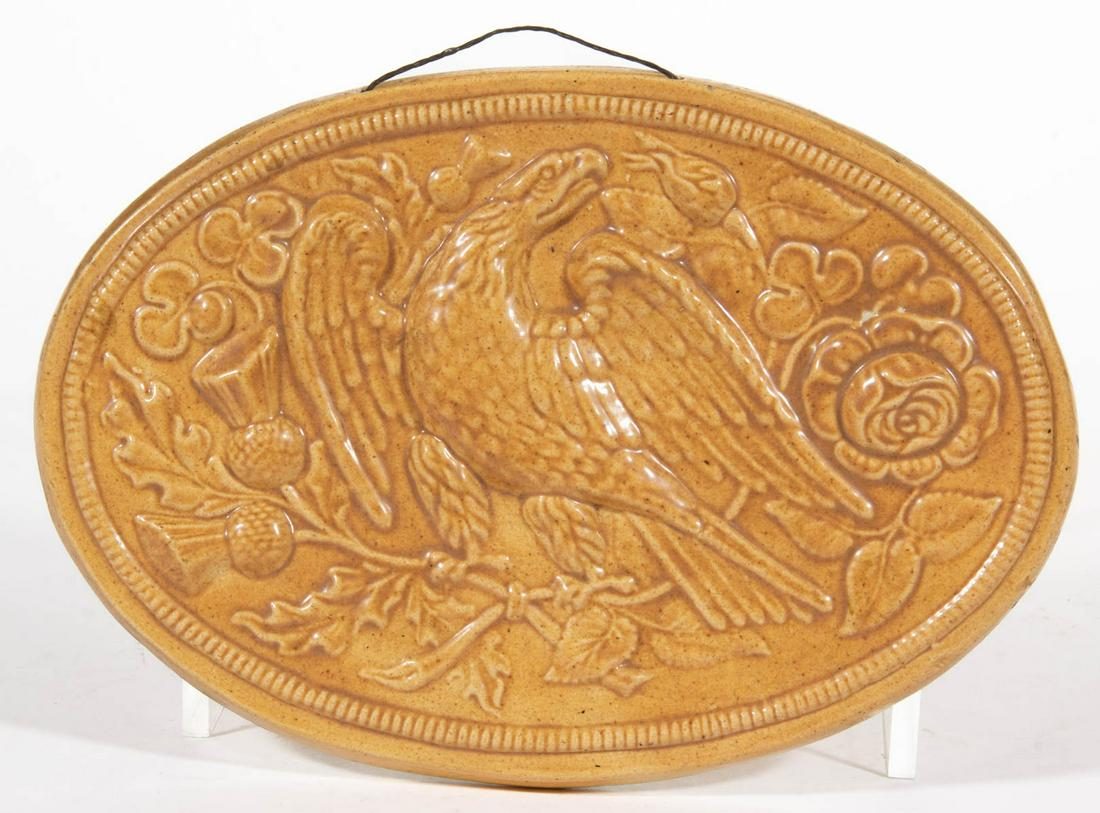
Finally, my search of previous auctions led me to a sale of the following plaque:
This was sold by Jeffrey S. Evans & associates auctioneers as an “American Historical Eagle Yellowware Plaque”. Also of interest, an authentic Baltimore Equitable mark sold in the same auction, March 5th, 2022. We know fire marks could be issued with several different materials, but I am unaware of any American mark being issued with this material. Other searches revealed this image was used as fireplace andirons, with reverse images on either side.
While this is truly a beautiful plaque/sign, and I would like to believe that B.240 is a fire mark, I’m leaning more towards the argument against it. Why don’t we have any idea of the company information? Why would there be two marks with reverse images? This seems like it would be more of an ornamental item. If you have any further information or comments the editor would love to hear your thoughts!