The ABCs of American Fire Marks
Company histories of the Forest City Insurance Company of Rockford, Illinois, and the German Insurance Company of Freeport, Illinois, which was ruined by the 1906 San Francisco fire.
By The Old Underwriter
F is for the Forest City Insurance Company, Rockford, Illinois, Bulau 445 & 445X1
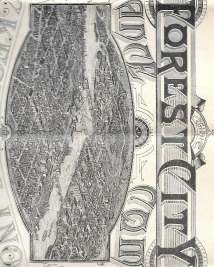
The Forest City Insurance Company commenced business on August 13, 1874 with a paid capital of $100,000. Its name “Forest City” is the nickname for the city of Rockford. The incorporators were so proud of their fair city that they used the city landscape in the masthead for its policy, the center of which is shown below.
The company confined its business to farm property, town dwellings, churches and schools in Illinois and only wrote the perils of fire, lightning and tornado. Conscious of what was transpiring in the insurance world at the time, its early advertising stressed that they did not have any risks in Chicago and did not make assessments.
The Forest City made continuous progress over the years, paid its claims fairly and had a good reputation. Years of low losses enabled the directors in 1899 to increase its capital to $200,000 by declaring a dividend from the surplus.
In 1912 there was a change of management with a new president and secretary and two years later the National Fire Insurance Company of Hartford purchased its stock and reinsured the business.
For a number of years, the company paid dividends of 18% and just over $900,000 in cash dividends since organization. Now that’s what I call good underwriting.
G is for the German Insurance Company of Freeport, Illinois, Bulau 364-67 & five Addenda pages.
Originally organized in 1865 as the Freeport Insurance Company, a mutual, the company did little business and sold its charter to a group of German businessmen. after receiving approval from the legislature, the company reorganized as a stock insurance company under the name of German Insurance Company of Freeport on March 14, 1867.
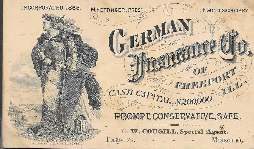
As evidenced by the above trade card, the company emphasized its German roots and for many years the policies were both English and German. With its extensive use of testimonials for claims payments in local newspapers the company grew and prospered. The company expanded to other states and was one of the first insurers to write tornado and cyclone insurance. They were so innovative in Kansas that if the insured did not have the money, the company would insure now and wait till the crops were harvested at no extra charge. At one point, they would not write saloons in small cities due to the potential fanaticism of the Temperance Movement. Ever conscious of their image, they gave donations to area fire companies and even donated $1,000 to the Freeport Library.
Immensely popular and profitable with 2,500 agencies in states from coast to coast, the German was fiercely independent and generally refused to join associations that set rates. In Wisconsin, they combined with the Milwaukee Mechanics’ Insurance Company in 1895 to form the “Wester Underwriters Agency” to enable the company to write larger risks.
The German Insurance Company’s world collapsed on April 18, 1906 due to the San Francisco earthquake and subsequent fire. Its annual report for the end of 1905 showed assets of $6.2 million and surplus to policyholders of $2.1 million. Up until about August 1906 the word on the street was that the German would pay its losses. With losses estimated as high as $6 million the German offered to pay 60%. While many claimants settled, attorneys convinced others that they should sue to get at the assets of the German. Having failed to raise additional capital to continue the company, the directors reinsured with the Royal Insurance Company of London and retired the company.
Illinois appointed a receiver and the California attorneys sued to stop the payment of about $3 million reinsurance funds to the Royal. After a year and a half, the California claimants finally received about 58% of their claims, the attorneys received about $200,000, the Royal significantly increased its share of the US market and the German Insurance Company was gone.
Lulled by the long period of expansion and profitability the German Insurance Company seems to have forgotten about the underwriting adage of watch out for the catastrophic risk.