
Firemen's Insurance Companies: Associated Firemen's Insurance Company of Baltimore (Bulau 166)
The charter provisions, management, and 1900 absorption by the Fidelity Fire of a Baltimore insurer organized for the volunteer fire department.
By Bob Shea
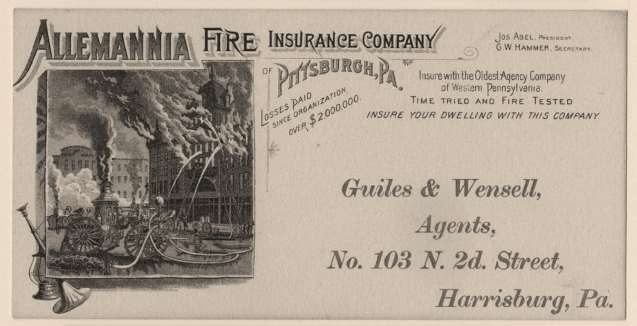
The Associated Firemen's Insurance Company of Baltimore began life on March 10, 1846, when it was charted as an insurance company under the name of the "Association of Active Firemen in the City of Baltimore."[1] Feeling that the act was inadequate to form an insurance company as promptly as desired, it was repealed and replaced on March 9, 1847[2] with an act chartering the Associated Firemen's Insurance Company. A review of the charter's various sections show that the company was organized for the benefit of the volunteer fire department:
Stock
- The capital stock was $67,500 with 13,500 shares at $5 each. $2 was paid for each share at subscription with an additional $1 sixty days after the company began operations, $1 sixty days later, with the last $1 sixty days thereafter. Capital stock could be increased up to $300,000.
- Only members of a fire company could subscribe to stock. Each of the seventeen fire companies could subscribe to 200 shares for its own use and the individual members could subscribe to an additional 550 shares. After one year, shares not subscribed by the company could be taken by the members.
- The Baltimore United Fire Department, organized in 1834 to promote uniform supervision of the volunteer firemen, could subscribe to 750 shares.
- A stockholder who ceased to be a member of a fire company had sixty days to transfer his stock to a fire company, fire company member or the Baltimore United Fire Department. After the sixty days, the stockholder would not receive any portion of the company's profits.
- Shares of a deceased stockholder had to be transferred to a member of a fire company within two years. A member could hold in trust for the benefit of the widow or children, but when the child became of age they must become members of a fire company
- Business began as soon as 5,000 shares were subscribed.
Directors
- The directors had to be stockholders and elected a president from their own body or other stockholders. Previous to entering their offices they had to take the following oath, "I _______ do swear, or affirm, as the case may be, that I will faithfully, diligently, impartially and honestly fulfill the duties of my office of ________ to the best of my knowledge and ability."
- There were not a stated number of directors. However, each company with 200 shares was entitled to one director. The Baltimore United Fire Department was also entitled to one director provided they held 200 shares.
- The directors were elected in each fire company, each company a stockholder and each individual stockholder had one vote, and the person having the highest number votes was chosen as the director.
- No director of any other fire insurance company could be a director of the company.
- The directors and president could appoint a secretary, clerks and other officers to transact business and allow them salaries, including compensating the president.
Miscellaneous
- The company was authorized to make all kinds of fire insurance only within the limits of the city of Baltimore. (The limitation to Baltimore was repealed in 1865.[3])
- 50 stockholders, who together own 500 shares, could at any time apply to the president and directors to call for a general meeting of the stockholders. Should the board refuse, the stockholders may on their own call for a general meeting by publishing at least a fifteen day notice in the newspapers stating the object of the meeting.
- Fire company members were entitled to a 5% discount on their insurance.
- Dividends on profits were payable semi-annually, but not exceeding twelve and a half percent, with the remainder of profits retained as a reserve fund until the fund accumulated $50,000. Once this fund accumulated $50,000, profits over twelve and a half percent could be declared equally between the fire companies and the United Fire Department. (In 1852 this was replaced so that the board was authorized to make, at its discretion, donations to the fire companies. It appears that the Baltimore United Fire Department did not subscribe to its allocated 750 shares.)
- Dividends could not be paid where losses reduced the capital stock until profits replaced the capital.
- The company was not authorized to issue any note, script or any debt to be used as currency.
The volunteers, operating under the Baltimore United Fire Department, were replaced by a paid department with an ordinance passed on December 10, 1858.[4] Although not in active service, the United Fire Department did not disband immediately. Recognizing the inevitable, the Associated Firemen's Insurance Company inserted the following preamble to its December 19, 1861 charter amendment:
WHEREAS, The city of Baltimore having established a Paid Steam Fire Department, and the Volunteer Fire Department being about to disband, it becomes necessary to provide for the election of directors….instead of as at present by the stockholders in the respective fire companies composing the Volunteer Fire Department; ….[5]
The amendment repealed sections relating to the restrictions of stock ownership and directorship to members of a fire company, the 5% discount to firemen, and fixed the number of directors to fifteen. Most likely, in an effort to prevent the control of the company by individuals with large blocks of stock, new directors were chosen as follows:
- One votes for each share up to five,
- One vote for every five shares over five shares up to fifty,
- One vote for every ten shares over fifty shares up to one hundred & ten,
- One vote for every twenty shares over one hundred & ten, but no person could have more than thirty votes.
Always smaller than the Firemen's Insurance Company, the Associated Firemen's prospered. Even though the company was authorized to write insurance outside Baltimore, their efforts to do so were half-hearted and confined to Maryland, primarily in Baltimore. For years the company had modest losses and paid dividends of around $20,000 per year. However, Maryland business in the late 1890s became unprofitable with mergers and retired companies as a result. The stock of the Associated Firemen's Insurance Company was purchased by the newly organized Fidelity Fire Insurance Company of Baltimore in 1899 and in 1900 the company was absorbed by the Fidelity Fire.
Notes
- Maryland State Archives. Session Laws, 1845. Volume 611, pp. 419-427, Chapter 372. Archives of Maryland Online.
- Maryland State Archives. Session Laws, 1846. Volume 611, pp. 17, 340-348, Chapter 352. Archives of Maryland Online.
- Maryland State Archives. Session Laws, 1852. Volume 615, pp. 161-162, Chapter 167. Archives of Maryland Online.
- Forrest, Clarence H. Official History of the Fire Department of the City of Baltimore: Together with Biographies and Portraits of Eminent Citizens of Baltimore. Baltimore: Williams & Wilkens, 1898, p. 103. Google Book Search
- Maryland State Archives. Session Laws, 1862. Volume 532, pp. 9-11, Chapter 7. Archives of Maryland Online.