Can These Insurance Agency Signs Be Fire Marks?
A history of American fire marks and the agency system, arguing that the New York Underwriters', Adams and Michael Kirsch agency signs qualify as fire marks.
By Bob Shea
The short answer to the above question is that insurance agency signs are fire marks. I hope to show in this brief history of American fire marks that by their early use, the development of the insurance industry and the agency system, these insurance agency signs are fire marks.
A Fire Mark is an Insurance Sign
Alwin E. Bulau in Footprints of Insurance designated the word “signevierist” as a collector of fire marks. According to Bulau, the word is from the Old French signe, meaning sign or mark, and vier, the Flemish root of the word fire. The dictionary lists a number of meanings for the word sign. The definitions relevant to this discussion are that a sign is “a mark or symbol having an accepted and specific meaning” and “a publically displayed board, placard, etc. bearing some information or advertisement.”[1] It’s probably no coincidence that Bulau selected Holger Cahill to author the “Introduction” to his Footprints of Assurance to express the idea of how insurance company fire marks represented the beginning and development of insurance in America. One of the ideas that Holger Cahill, an authority on the folk art of the United States and national director of the Federal Art Project of the Works Projects Administration from 1935 to 1943, expressed was that “Fire marks are trade signs.”[2]
Early trade signs typically used symbols to identify business establishments either by the type of business, such as a mug full of ale for a tavern, or a business name, such as a “red bull” for the Red Bull Pub. So too, most of the late 18th century American insurance companies’ signs displayed visual symbols or emblems such as clasped hands, a green tree, or an eagle. These symbols could certainly be seen as trade signs. However, there was one 18th century American insurer that did not use a symbol but only showed its name and policy number on the mark, the Mutual Assurance Company for Insuring Houses from Loss by Fire in New York. While this mark does not have a symbol, it fits the dictionary meaning of sign as an advertisement. By 1825 half the American insurance companies that issued signs were displaying their name rather than using a symbol or emblem to represent their company. In fact, the predominance of all American fire marks show the company name without a symbol.
Not All Insurance Signs are Fire Marks
A fire mark is a particular type of insurance sign that was designed to mark a property that was insured against loss by fire and were fixed on the front of a building in a prominent place so that it could be easily seen. For example, in 1819 the Aetna Insurance Company wrote to its agents:
You will also be furnished with advertisements, to be posted up in the most advantageous and public places in your vicinity, as also with tin labels to be delivered to the insured, to be posted over the door, or in some other canspicious [sic] place of the building insured.[3]
It’s pretty clear that “tin labels” refers to Aetna’s early fire marks.
Definition of a Fire Mark
At this point, I propose the following working definition: “A fire mark, also known as a “badge”[4] or “house plate,”[5] is an insurance sign designed to be placed on the front of a property to indentify it as insured for fire.”
Insurance in the Midwest
As the country and business expanded, people realized the importance and necessity of fire insurance, especially in the large cities. Most insurance companies operated locally under the supervision of their directors. However, after the 1835 New York City conflagration with the resultant failure of most of the cities insurance companies due to concentration of risk, the Eastern insurance companies saw the need to expand their markets and establish contracts with local agents throughout the South and Midwest. At the same, due to ease of entry and lack of state supervision numerous local insurance companies were also organized, both stock and mutual, with some mutuals issuing mutual and cash policies. At this point in the development of the insurance industry the competitive environment was difficult, rates were low and policy forms were not standard. In addition, numerous stock companies were organized with little actual capital but with notes and mortgages. Many of these companies were more interested in paying dividends to stockholders than holding reserves for policyholder security.
Having forgotten the lessons of avoiding catastrophic exposure and adequate firefighting protection learned from the 1835 New York City conflagration, the industry experienced catastrophic losses in the 1871 Chicago Fire and the 1872 Boston Fire. This time the reaction was more subtle, almost evolutionary in nature, as there were more informed entities involved. The National Bureau of Fire Underwriters, organized in 1866, sharply increased rates and local rating boards followed suit. Agents organized and created local and state boards to standardize both rates and policy forms. State insurance departments required adequate reserves and examined capitalization more closely.
This later period has been called by some insurance writers as the era of co-operation[6] and by the end of the 1880s the daily report, insurance town maps, rating bureaus and the company field man enabled the industry to grow, and, along with state regulation, to improve its ability to withstand catastrophic fires as well as economic declines.
Fire Marks in the Midwest
Insurance companies also competed by using fire marks, more commonly known in the Midwest as “house plates.” Except in a few instances, fire marks used in the Midwest showed only the name of the company. A fire mark with the name of a well capitalized and established company from the East presumably gave the insured added security, and in 1857[7] the Aetna again encouraged it agents to place them on newly insured properties. Over 100 insurance companies organized from 1860 to 1870 issued fire marks, with 70% of these from the newly organized companies in the Midwest. Like an animal that leaves its scent, the insurance companies left their fire marks to mark their territory and their growth.
New York Underwriters’ Agency
With so many insurers which one should a property owner choose? If they only had to insure a dwelling, there was almost an unlimited number of national and local companies to choose from. However, if they owned a high valued property, there was a problem. In the 1850s and 1860s insurance companies would only provide modest amounts on their own. The insured had to go to a large agency or broker to secure policies from three of four different companies with each company providing a separate policy with the resultant problem of different policy forms.
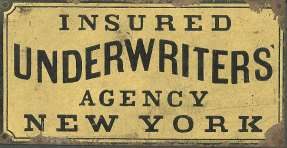
To solve this problem, Alexander Stoddart, in 1863, convinced four reputable New York City insurers, the Germania Fire, Hanover Fire, Niagara and Republic Fire, to issue a single policy in which each would assume its proportionate share of the policy. In this way the insured had a policy backed by assets as large as the largest insurance companies of the day. Under a five year agreement, Mr. Stoddart, as the general agent, would appoint local agents, underwrite the business himself, issue the policy, and pay losses. Since the new firm was an agency that underwrote the insurance and was located in New York, the policy was issued under the name of the “New York Underwriters’ Agency.”
Another advantage was that the four New York insurers could now enter new territories and the expenses of opening new offices, advertising, underwriting, issuing policies, as well as supervision and management of personnel, was handled by the Agency. This was a revolutionary idea for the fire insurance industry. The new business model was tested when the Underwriters Agency entered the South soon after the Civil War and expanded in the Midwest. So successful was the Underwriters Agency that by 1866 there were more than 500 agents throughout the South and Midwest.[8] The agency contract was extended for five more years and at the end of ten years, the two companies that renewed it for another ten years, Germania and Hanover, were larger than the four combined had been ten years earlier.[9]
An Insurance Entity In Its Own Right
Alexander Stoddart always maintained that the New York Underwriters Agency was a business entity separate and distinct from the companies it represented. So forceful was this idea that the Underwriters Agency held individual membership in the various underwriting organizations wherever they did business, such as the National Bureau of Fire Underwriters, the New York Board of Fire Underwriters, and the Fire Underwriters’ of the Northwest. Whether at the local level, where the agency presented a fire trumpet in 1868 to the Pioneer Engine Company #1 of Watertown, Wisconsin,[10] or at the national level, where its agent Colonel Samuel B. Paul instituted the celebratory insurance suit of Paul vs. Virginia, the Underwriters Agency was always prominent. Its firsts included the use of the daily report, first typewriter form of policy with carbons and first simplified dwelling policy.
The idea as a distinct company was even carried to their fire mark. Note the phrase “Insured By” on their fire mark. Many Midwest policyholders expected to receive a fire mark. Since the policy was in their name and they would be there to handle any claims, they issued a fire mark in their name, New York Underwriters Agency, not in the name of one of the companies they represented. In 1867, their fire mark would have represented the assets of four companies with over three million dollars of assets and the security that only a few companies in the East could match.
Fire Marks in Ohio
In addition to the Eastern insurance companies that issued fire marks, Ohio has the greatest number of state fire insurance companies (55) that issued fire marks in the United States. For some reason the Ohio insurance companies used fire marks extensively with at least five Ohio firms manufacturing them in the last quarter of the 1800s.[11] While we can’t determine when this phenomenon began in Ohio, we can document that the practice continued up to at least 1889, which is the organization date of the Standard Advertising Co. Most likely fire marks were issued up to the end of the 1890s, but not much after.
The Adams and Kirsch Agencies
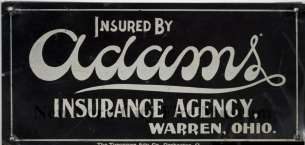
It is no coincidence that the two local agents who issued fire marks are from Ohio. The Adams Insurance Agency of Warren, Ohio, was founded 1857, the same year its founder, Whittlesey Adams graduated Yale University. Always involved in business affairs and a member of the bar, Mr. Adams was an active member of the volunteer Neptune Fire Engine Company.[12] His primary interest was the insurance agency, which represented the largest American and European insurers. So successful was the agency that in one year the agency paid over $500 to the Trumbull County treasury and for several years paid more than the total paid by all other insurance companies in the county.[13] The agency was in existence for over one hundred years, and represented the Home Insurance Company of New York for over seventy-five years.
By the 1870s the agency had some ninety subagents in nine or ten counties.[14] Handling insurance for numerous businesses throughout Ohio, the Adams Agency issued an insurance sign that was placed on property insured by the agency. The Adams Agency fire mark was issued between 1887 and 1901, which correspond to the dates of the sign’s manufacturer, the Tuscarora Advertising Company. About this period the use of fire marks sharply declined in the United States both by existing and newly organized companies. The Adams Agency simply filled the void. Certainly the agency was known by the companies it represented with the result that the agency sign noting that the property was “Insured By Adams Insurance Agency” imparted just as much a sense of security to the policyholder as did the actual insurance company’s fire mark. This most certainly was an insurance sign that was placed on the front of a building to identify it as insured for fire, and therefore meets the definition of fire mark.
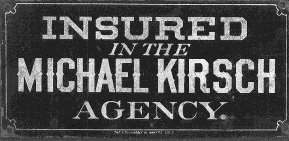
The Kirsch agency is listed in numerous editions of The Insurance Year Book between 1881 to 1916. Even though the agency mark shows the manufacturer, F. Tuchfarber Company, no date of issue can be determined. Most likely the agency mark was issued sometime between 1881 and 1902. Since there were numerous competing insurance agents in Chillicothe, the agency would mark the front of a building that the property was “Insured in the Michael Kirsch Agency.”
Agency Signs
By the 1880s fire insurance was an economically accepted fact. Banks and mortgage companies required borrowers to purchase insurance and responsible family men insured their homes and furnishings. Fire insurance was going through an evolution with the creation of rating, underwriting and agent associations, and standardization of policy forms. State regulation tended to level the playing field for the companies. There seemed to be a feeling of certainty about the insurance industry.
The sign of the New York Underwriters Agency was most likely issued prior to the 1880s because, as an underwriting agency, its competitors were other insurance companies. However, the Adams and Kirsch agency signs were used during this later period of certainty, where, to the insured, it was the agent who represented the insurance company. To differentiate themselves from other agencies, they simply updated the older style insurance company marks that were placed on the front of insured buildings. Since the older company marks were still in use by some of the companies, and the marks of long gone companies could still be seen on properties, it would not be difficult to convince some policyholders to allow the agency to put their signs on the property.
Conclusion
Just as the American insurance industry evolved, so too did its signs or fire marks. Beginning with the symbols of the 18th century Philadelphia insurers and the later marks bearing an insurance company name, the fire marks bearing the notations “Insured Underwriters Agency, New York,” “Insured By the Adams Insurance Agency” and “Insured in the Michael Kirsch Agency” conveyed the same message of insurance protection. Not to call these agency signs fire marks is somewhat analogous to the discussion of fire mark or plate. It is its function that determines whether it is a fire mark, plate or sign. It’s a fire mark if it was placed on the front of an insured’s property to identify it as insured for fire.
With that in mind, I see no reason to revise the earlier definition of a fire mark: “A fire mark, also known as a “badge” or “house plate,” is an insurance sign designed to be placed on a property to indentify it as insured for fire.”
I welcome the thoughts and comments of FMCA members and will be happy to publish them in future newsletters.
- Webster’s New Twentieth Century Dictionary, Unabridged. Second Edition.
- Bulau, Alwin E. Footprints of Assurance. New York: The MacMillan Company, 1953, p. XIII.
- Instructions and Explanations for the Use and Direction of the Agents of the Aetna Insurance Company. Hartford, Conn: Aetna Insurance Company, September, 1819, p. 9.
- At the Sign of The Hand-In-Hand. The Philadelphia Contributionship for the Insurance of Houses from Loss by Fire. May, 1935, Second edition, reprint of 1926, p. 15. And Charter and By-Laws of The Trustees of the Fire Association of Philadelphia. Philadelphia: D. and S. Neall, 1826, p. 12.
- Instructions for the Use of Agents. Hartford, Conn: Aetna Insurance Company, 1857, p. 32.
- Oviatt, F.C. Historical Study of Fire Insurance in the United States. The Annals of the American Academy of Political And Social Science, Vol. XXVI, No. 2, September, 1905, p. 350ff. Google Book Search. And Baranoff, Dalit. Shaped by Risk: The American Fire Insurance Industry: 1790-1920. Ph.D. dissertation, The Johns Hopkins University, 2004, p. 157ff.
- Instructions for the Use of Agents, op. cit.
- The Conquest of Fire. New York Underwriters Agency. New York: The Search-Light Library, 1914, Part Two, Chapter Two., pages not numbered.
- The Conquest of Fire. Ibid. Chapter Four.
- Riedl, Ken, et al. Watertown Fire Department, 150 Years, 1857-2007. Watertown Historical Society, 2007, p. 44. Google Book Search.
- The five Ohio firms that manufactured fire marks are: Strobridge & Co. and The F. Tuchfarber Co., both in Cincinnati; Standard Advertising Co. and Tuscarora Advertising Co., both of Coshocton, Ohio; and The Toledo Metal Sign Company, Toledo.
- Upton, Harriet Taylor. A Twentieth History of Trumbull County Ohio. Volume II. Chicago: The Lewis Publishing Company, 1909, p. 10. Google Book Search.
- Atlas and Directory of Trumbull County, Ohio. Cleveland, Ohio: The American Atlas Company, 1899, p. 148. Google Book Search.
- One Hundred Years of Insurance, 1857 – 1957, The Adams Insurance Agency Company. Western Reserve Historical Society. p. 4.