
Bulau 381-382
Bob Shea reviews conflicting attributions of the State Mutual fire mark and argues it belongs to the State Insurance Company of Hannibal, Missouri, 1865-1873.
By Bob Shea
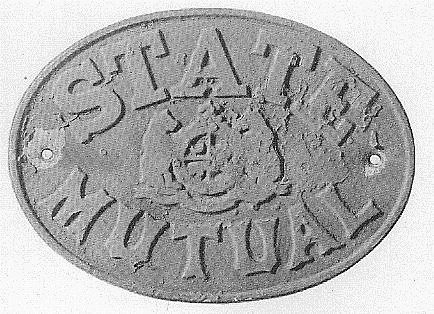
Alwin E. Bulau in Footprints of Assurance, 1953, p. 99, attributes marks #381-382 to the “State Mutual Fire and Marine Insurance Company, Hannibal, Missouri, 1865-1873.” However, not everyone has identified them the same way. The Insurance Company of North American in its 1933 publication, American Fire Marks, p, 96, attributes the mark to the “State Mutual of St. Louis, Mo.,” founded in 1865. Note that the name did not include “Fire and Marine” and the city was St. Louis, instead of Hannibal. Kenneth Dunshee’s Engine!~Engine!, published in 1939, p. 42, listed the company name as “State Mutual Fire and Marine Insurance Co., Hannibal, Mo., Org. 1865.” Finally, INA’s The Historical Collection of Insurance Company of North America, 1792-1967, p.77, uses the same attribution as Bulau.
A review of sources on the Web points to a third alternative company name. It was found that there was no “State Mutual Insurance Company” or “State Mutual Fire and Marine Insurance Company” organized in St. Louis. Also, there was no “State Mutual Fire and Marine Insurance Company” organized in Hannibal, Mo. All the attributions agree on an 1865 organization date. The “State Insurance Company” of Hannibal incorporated on February 15, 1865 is the third alternative name.
The incorporation act found in Laws of the State of Missouri, Passed at the Regular Session of the Twenty-Third Assembly, Begun and Held at the City of Jefferson, on Monday, December 26, 1864, Jefferson City, W. A. Curry, Public Printer, 1865., pp.203-206, shows that the company was not organized as a mutual insurance company. It was a hybrid form of stock company.
The capital to run the company was raised by:
“The cash premiums, together with the deposit notes, shall constitute the capital stock of said company, which may be increased by a guarantee capital as hereinafter provided.” Section 19 provided: “… the said company may receive guarantee notes of mortgages on real estate…to the amount of three hundred thousand dollars. The makers thereof shall be paid …a compensation … not to exceed ten per cent. Per annum. Such notes or mortgages shall be entitled to representation in the election of directors in the ratio of one vote for every one hundred dollars…. Whenever the cash premium and deposit notes are insufficient to pay the same, script certificates may be issued for any guarantee fund, transferable only on the books of the company.”
This seemed to be risky business as there was no cash paid by the people who could vote for a director of the company.
While the word “mutual” is not used in the charter, Section 6 states:
“…deposit notes may be received from the insured, which shall be paid at such time or times and in such sum or sums as the directors shall require for the payment of losses and expenses. Any person applying for insurance may pay a definite sum of money in full for said insurance, and in lieu of a deposit note.” Section 8 states that, “The members of this company shall be and are hereby bound to pay their proportion of all losses and expenses happening and accruing the during the time for which their policies were issued and in force and to the amount of their deposit notes and no more.” To further indicate the mutuality of the company, Section 11 states the election of the board of directors, “…shall be made by a plurality of the votes of the members present, or their proxies, allowing one vote for each policy held and in force, or share of guarantee stock held.”
The name “State Insurance Company” indicates this was a stock insurance company and its charter shows that it also issued policies on the mutual plan. Stock insurance companies issuing both stock and mutual policies was permitted in Missouri. [Refer to the following articles in prior issues of The Signevierist: “Franklin Insurance Company,” p. 5, Issue Number 1010-4 and “Mutual or Stock Insurer? Jefferson Mutual [Fire] Insurance Company, Bulau 379,” pp. 1-3, Issue Number 2009-3.]
It appears that writing both stock and mutual policies was not working out and on March 4, 1869 the charter was amended so that, “…no new business, on the mutual plan, shall hereafter be transacted by the company, but when the existing policies are cancelled or terminated that class of their business shall cease.” Also, to address the lack of actual money raised by the guarantees secured only by notes and mortgages, Section 19 was amended:
“For the better security of policy holders, the said company may add a stock capital of not less than one hundred thousand dollars...Said stock shall be divided into shares of one hundred dollars each, and at least twenty dollars shall be paid, in cash, on each share, and the remaining eighty per cent. shall be secured by mortgage on real estate, worth at least double the amount secured, or by a note, with two responsible sureties, or by deposit of United states or other approved bonds or stocks.’ [Laws of the State of Missouri, Passed at the Regular Session of the Twenty-Fifth General Assembly, Begun and held as The City of Jefferson, Wednesday, January 6, 1869, by Authority. Jefferson City, Ellwood Kirby, Public Printer. 1869, pp. 181-183]
The word “Mutual” on the company’s fire mark was somewhat of a puzzle. Why have “Mutual” on the fire mark if the company was not a mutual? No doubt the State Insurance Company of Hannibal would want to write insurance in St. Louis. Thirteen of the fifteen St. Louis insurance companies that issued fire mark were mutuals. Besides, the mutual plan was all the rage in Missouri at the time. As a stock company, who also wrote on the mutual plan, it would make business sense to advertise the word “Mutual” on their fire mark. In that way, they could compete with the other mutuals.
Based on the above, Bulau’s marks #381 and 382 should be attributed to:
State Insurance Company
Hannibal, Missouri
1865 – 1873