
The Fire Association of Philadelphia
History of the Fire Association of Philadelphia from its 1817 origins among volunteer fire companies to its 1958 renaming as the Reliance Insurance Company.
By Bob Shea
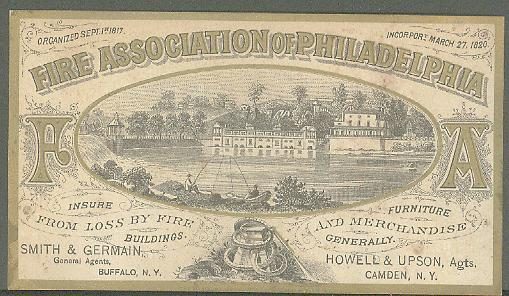
THE FIRE ASSOCIATION of Philadelphia is the first insurance company in America to grow out of the volunteer fire companies and traces its organization to the development of firefighting.
With the establishment of the waterworks system in 1801 a whole new group of fire companies were organized to provide the engine companies with hose to connect the hydrant to the engine. In 1805 the Fire Hose Association was formed to represent hose companies in dealing with city government, coordinate efforts at fires, settle disputes and set territorial boundaries for the companies. The Fire Hose Association only had limited success and was replaced by the Fire Association in 1817, which was charted March 27, 1820.
The 1820 act of incorporation provided for the formation of two separate entities, the first was “The Fire Association of Philadelphia,” which incorporated the eleven engine companies and five hose companies in Philadelphia “…to promote harmony and friendly intercourse among them, to establish those just relations that ought to exist among institutions whose views are similar, and to enable them more effectively to perform those philanthropic duties…” The second, “The Trustees of the Fire Association of Philadelphia,” incorporated the fire insurance company. The thirteen trustees (directors) appointed by the fire companies for one year had the power to enter into contracts of insurance. The trustees, for organizing and insurance company, “..were debarred from having or receiving any salary…” but “…shall appoint such officers as they deem necessary, [and] establish their several compensations…” In addition, the trustees were “…made personally liable for all damages arising from the insurances effected in pursuance of this act, where such damage shall amount to more than the whole capital stock of the said association, except where such personal liability is relinquished by the person or persons insuring, expressed in writing at the time of making the insurance…” [Charter of The Trustees of The Fire Association of Philadelphia, Philadelphia, D. and S. Neall, No. 2, Hartung’s Alley, near Christ-church, 1826.]
Policy number one issued to Samuel Bleight on September 23, 1818 (eighteen months before the charter) contained the following provision:
“It is agreed and hereby declared, that the Trustees…shall not be made personally liable for damages arising from this insurance, in case the said damages…shall amount to more than the whole capital stock…; and such personal liability is hereby expressly relinquished…and binds himself to look to the said capital stock, and to that alone for his indemnity against any and every loss which may happen under this Policy; and acknowledges and admits that at the time of effecting this insurance there is exhibited to him a semi-annual statement of the actual capital of the said Association…”
Such language clearly shows how much faith the public had in the integrity of the firemen.
Insurance was written with the expectation that profits would enable the trustees to “…appropriate such sums as they may judge necessary to reward those who are voluntarily active in extinguishing fires…” It was also anticipated that dividends from profits would be paid to the fire companies in the association. Because the capital stock only consisted of the property and funds now in the their hands and any such money that may “…accumulate from deposit money, premiums, interest and other sources…” no distribution could be made until the capital stock was $15,000; and then, as determined by the semi-annual statement, only one half the interest provided the capital stock did not go below $15,000. Once the capital stock reached $50,000, regular dividends from profits could be paid. As an added benefit, the members had the privilege of a 5% discount on insurance.
While it was a risky idea to start an insurance company without any capital, the men the trustees appointed as officers were men with talent for organization and experience in underwriting. Michael Fox, president of the Diligent Engine Company was chairman/president of the trustees and the president of the insurance company. The insurance operations were guided by the secretary and treasurer, Caleb Carmalt, who was formerly the clerk of the Philadelphia Contributionship for forty two years and for ten years its treasurer. John Ogden, surveyor, was a founding member of the United States Engine Company and measurer for Philadelphia’s Carpenter Company. The selling of insurance was encouraged and the Fire Association issued fire marks to policyholders. It didn’t hurt business that it was rumored that buildings with their fire plug emblem should be the first to receive attention in the event of a fire.
By 1833 there were 4,500 perpetual policies on the books with seven million dollars at risk. The Association reincorporated to eliminate any personal liability of the trustees with the new corporation taking on any liability to pay losses and having title to the Association’s assets. Pride in the Fire Association was such that at the sixteenth anniversary a grand parade of member companies was held with twenty eight engines and seventeen hose companies marching ten miles through Philadelphia. There were at least sixteen hundred men forming a line more than a mile in length, and a Ball that evening was attended by 800.
As a result of a conflagration fire in 1850 the Association incurred $93,000 in losses, which represented a loss of almost all its surplus, the accumulation of thirty-three years underwriting. The trustees issued a joint note in their names to obtain a bank loan and converted the assets of the Association into cash. Philadelphians responded to the Association’s ability to pay its losses so enthusiastically that its surplus was replaced by new business in the next four years.
Having paid its first dividend of $150 in 1845 to each member company, a 1856 supplementary act limited dividends to 30% of the profits and income until the permanent capital stock [surplus over all liabilities] reached $200,000. Business was so good that a dividend of $738 was paid to each of its forty-nine members.
The success of the Association and its ability to make money through its insurance operations helped to organize an association for the relief of disabled firemen and set up a board of control for the fire department. In 1861 the Fire Association even floated the idea of contracting with the Philadelphia government to perform firefighting duties for $64,000 a year. While perhaps a good idea on the surface, (Philadelphia was already paying money to each company) not all the member companies were in agreement and the idea was dropped. In 1862 the Fire Association went to Trenton, New Jersey, to encourage the city volunteers to form their own insurance company, but not all the volunteers were favorable, so the matter died there also.
The Association’s ability to settle disputes was limited since non-members lived in the outlying areas of the city, as well as differences in ethnic, religious and political affiliations. The firemen’s riots and violence of the 1840s made the volunteers targets for reform and by that time the insurance industry and city government were already pushing for a paid fire department with city control, already adopted in Chicago, (1858), and New York, (1865). While resisting city control, the volunteers adopted the technological changes brought by steam fire engines and alarm systems that created a division of labor and, ironically, the sense of a job that required a paid department.
On March 15, 1871 the paid Philadelphia Fire Department was organized and the Volunteer Fire Department disbanded. On May 5, 1871 the Fire Association obtained a new charter and continued as a stock insurance company under the title the “Fire Association of Philadelphia.” Each member fire company obtained 208 shares of stock and these shares were distributed pro rata among the members.
The new insurance company had assets over $1,700,000 and a board of directors consisting of four of the old trustees and nine new stockholders, who previously had no connection with the Fire Association. As a result of the Chicago fire with the resultant bankruptcy of insurers and the lack of insurers in the Midwest, the over fifty year policy of only writing business in Philadelphia was changed and the Fire Association opened a Western Department in 1872 and entered the agency system.
The Fire Association of Philadelphia insurance company continued to grow and operate successfully and in 1958 changed its name to the Reliance Insurance Company. The 1959 Best’s Insurance Reports noted, “The abandonment of the old title, with so much history and romance attached to the name, was decided upon for a variety of reasons. The motivating considerations were that the word ‘fire’ did not embrace multiple lines underwriting, ‘Association’ describes nothing except possibly a trade organization or a fire-fighting company and ‘of Philadelphia’ was no longer descriptive of the company’s world-wide scope of operations.”
It is a tribute to its founders and early managers that the company for so long successfully served the needs of the public for both firefighting and fire insurance. The Fire Association of Philadelphia was one of a handful of insurance companies so organized that continued into the modern era.