Fire Mark…Or What?
An enameled oval sign of the National Window Cleaners Assurance Society of Manchester, founded in 1914 under the Friendly Societies Act, and whether it counts as an insurance plate.
By Peter R.L. Faber
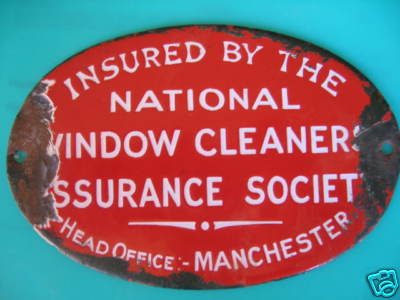
Recently I found a small “insurance sign” in Australia. This little gem is a 6” X 3 15/16” enameled oval from the National Window Cleaners Assurance Society of Manchester, England. The colors are a red background with white lettering. It proudly proclaims:
INSURED BY THE NATIONAL WINDOW CLEANERS ASSURANCE SOCIETY
HEAD OFFICE – MANCHESTER
Surprisingly, information about this company was easily found and I was quickly reading a file that tied the sign to an active organization, The Federation of Window Cleaners, formally The National Federation of Master Window Cleaners. Even more unusual, when contacted they were responsive, helpful, and most interested in assisting me in finding out more about the “sign.”
Albert Townsend Senior founded the National Window Cleaners Assurance Society in 1914 to provide financial relief in the form of Personal Accident & Sickness coverage, designed specifically for Window Cleaners. Per the Friendly Societies Act, its members would be drawn from the “trade guild or organization, it supported.
The society was organized and received a certificate to operate under the Friendly Societies Act of 1896 on the 10th August 1914. The certification was maintained under the Act until the 30th of September 2006. The Federation has retained the certificate in its corporate records.
A Friendly Societies Act was first established in the UK in 1807 to allow religious, trade, fraternal groups, and associations to solicit contributions or subscriptions from members to assist those members that suffered sickness, injury, death and limited property coverage from fire. As a point of interest, in the case of fire insurance the limit of coverage available was a multiple of the value of the “tools” used in the member’s trade, up to a maximum of X 15 the value of those tools.
The common belief is that the origins of these organizations are found with the suppression of guilds starting in the 16th century, and the burial clubs. As an idea, it was immensely successful, and with the Friendly Society Act of 1875, there were 47,909 “Friendly Societies” certified or enrolled under the various acts, covering 3,404,187 members.
The largest was The Royal Liver Friendly Society of Liverpool with 682,371 members. However, the average number of members in the 11,260 societies with membership under 10,000 was only 171. All the societies together held £9,336,946 in trust, no small fund at that time.
Where does the “Sign” fit into all this?
As we know, fire marks probably came into use in 1680 with the formation of The Fire Office. While it is believed they had a fire mark, and there is some documentation the support this, the first known fire mark was in 1683 with the formation of The Friendly Society in London.
With organized fire protection non-existent, the insurance companies established their own fire brigades to protect the property insured by that company. These insurance company fire brigades lasted into the late 1800’s, with the last, The Norwich Union in Worcester, disbanding in 1929
As cities and towns organized, the need of fire marks to identify property diminished, and by the end of the 1800’s their use was purely advertising. The last fire mark used to officially identify an insured structure was that of the Lion Fire Insurance Company of London, formed in 1879. After that fire marks are generally considered advertising, and often referred to as “plates”.
As it turned out “Fire Marks” were great advertising and a large percentage of the UK companies adopted their use. In fact their use spread throughout the world and were still in use into the second half of the 20th century, which brings us to The National Window Cleaners Assurance Society.
There were at least six insurance companies formed in the UK after 1914 that issued advertising “plates” the last recorded company to issue one was the Planet Assurance Company Limited in 1920. Roy Addis also lists three unrecorded, Lancashire & Cheshire Insurance Corporation Limited, Sovereign Fire, and, Property, in his book, “British Fire Marks”.
As these “advertising plates” were in common use, in 1914, when The National Window Cleaners Assurance Society was formed, it can be safely assumed that, wanting to further the insurance operations, management would consider using one of these plates, which in fact they did, hence the “insurance advertising sign” that is the topic of this treatise.
What do we know? The National Window Cleaners Assurance Society was formed in 1914 under the Friendly Societies Act of 1896. This Act permitted the society to make certain insurance products available to its subscribers (members). Personal Accident & Sickness coverage are two known products, but we don’t know what other insurance products, if any, were offered.
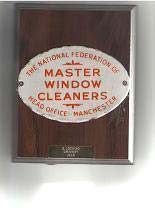
The National Federation of Master Window Cleaners had a plaque similar to the Assurance Societies’ “plate” that was given to members to affix to their ladder carts. As this plaque does not mention “insurance” it was probably a membership plaque. There is an example of this plaque in the Federations office.
Where does this leave the “plate” from The National Window Cleaners Assurance Society? In reading the Friendly Societies Act of 1896 it appears that those Friendly Societies that operated under a certificate, which this society did, were required to meet fiduciary standards more in keeping with normal insurance oversight. While there does not appear there was the formal regulation as found with insurance companies, there was an individual appointed by the government and charged with oversight. Operating under a certificate also dictated that actuarial standards for rates charged and proper accounting was required to insure the society was able to meet their obligations to the members, very much the same as any insurance company.
Unknown is how the society actually provided the coverage or payment for a claim. Were funds paid from the societies assets? Was there an insurance company in the background? Were accident and sickness the only products?
Based on what is currently known I have reached the following conclusions:
First, The National Window Cleaners Assurance Society was certainly an insurance organization operating under less stringent, but similar regulations as insurance companies.
Second, the sign in question qualifies as an insurance “plate” as it was issued by an insurance organization to promote public recondition that the organization provided insurance products.
Third, the companies that wrote accident and sickness policies provided ID cards or small tags to be worn on the person, and not a large “plate” designed to be nailed onto something.
Why did the Society use a “plate”? I believe that it was likely the society provided some sort of property or liability insurance for the members, perhaps property coverage on the ladders, carts, and other equipment. This would be a question worth trying to answer.
At any rate, I am convinced that this insurance advertising sign belongs in my collection of UK fire marks and am pleased to have found it.
My sincere thanks to Beryl A. Murray, General Secretary of the Federation of Window Cleaners, for her invaluable help in preparing this article.
Credits: “The British Fire Mark 1680-1879” by Brian Wright, 1982
“British Fire Marks” by Roy Addis, 2004