“House Insured Against Fire”
Bob Shea traces the French M.A.C.L. house plaques and identifies the unknown French fire mark BFR-MA-1 as a Paris mutual founded in 1816.
By Bob Shea
If you took away the insurance company name, logo, or historical crest from a fire mark, and inserted the above, you would have the makings of a basic fire mark. That is, people, upon seeing the sign, would know that the house was insured against fire damage. However, you may ask, but who is the insurer? Would it matter who the insurer was if there were only one company that provided fire insurance coverage?
While this may sound farfetched in today’s world, the above scenario was how property fire insurance began in 18th Century France. In 1753, Louis XV, king of France, granted only one company, the Compagnie Generale d’Assurances Contre les Incendies, (General Insurance Company), the authorization to provide fire insurance on houses. In turn, that company affixed to each insured house a plaque with the initials M. A. C.L., which stood for Maison Assuree Contre L’incinde, (House Insured Against Fire).
The plaque was known throughout France, and so ubiquitous in Paris, that at one point it was reported that the wags said the initials stood for “Marie Antoinette cockled Louis.”
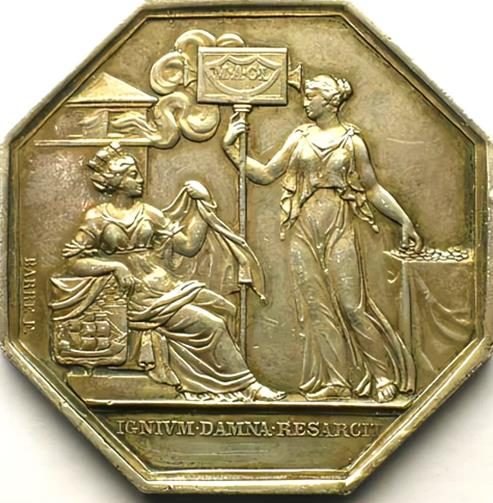
The development of modern fire insurance in France began in the early 19th Century. It was during this period that the mutual form of insurance began. One such company was the Société D’Assurance Mutuelle Contre L’Incendie, which was formed in 1816. Capitalizing on the familiarity of the earlier house plaques in Paris, the insurer was known by the initials in its name, “M.A.C.L.” In addition, the company also used “M.A.C.L.” on its house plaque, thereby obtaining free advertising for itself from the existing plaques on buildings. In 1818 the company changed its name to Société D’Assurances Mutuelles Immobilieres De La Ville De Paris. Below is the obverse of a jeton issued by the company sometime after it had again changed its name.
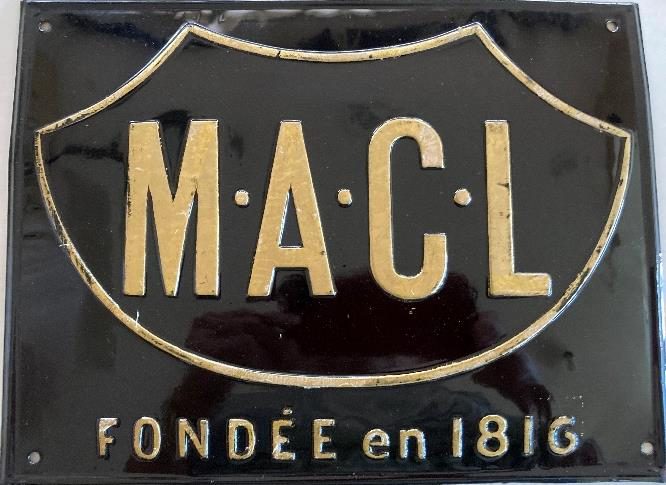
Below is a modern French fire mark that is listed in the Addendum as BFR-MA-1 with the company listed as unknown.
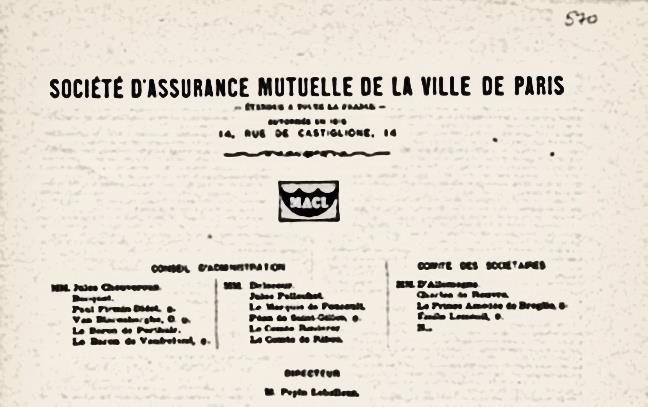
Based on the jeton’s image, it’s clear that the modern tin fire mark was issued by the same company or the current iteration of its name. After consulting the 1928-1929 International Insurance Intelligence, I found a Paris mutual, Société D’Assurance Mutuelle De La Ville De Paris, (City of Paris Mutual Insurance Company) that was established in 1816. After a few Google tries, I found an 1896 French document with the image below:
The emblem on the page is same as the jeton and the unidentified fire mark.
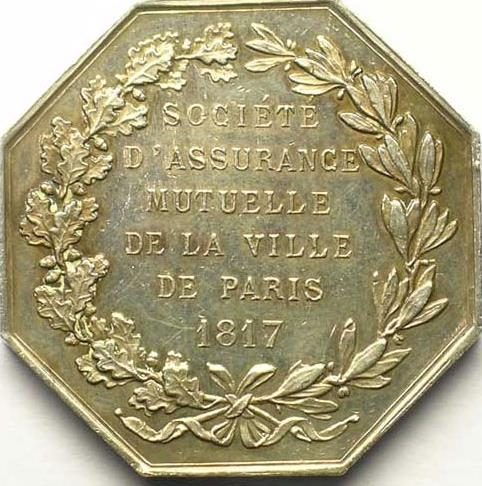
The reverse of the jeton in image 1, shown below, lists the founding date as 1817.
While the company was authorized in 1816, they successively extended for periods of thirty years, starting from April 1, 1817. Some sources use the 1816 date, while others use 1817. The confusion of dates even extends to a variant fire mark identical to image 2 except that the founding date is 1817, instead of 1816.
While researching French plaques or fire marks, I’ve learned that fire marks in France are more a part of the culture than the United States. I’ve seen reference to fire marks in humor, travel and even gastronomy. An aphorism in the 1828 “Code Gourmand: Complete Manuel of Gastronome” has “Vegetables are the insurance plate; against the fire of the stomach.” I guess that I should have eaten more vegetables as a kid. Also, in times of national unrest, mobs would tear down the fire marks with the symbols of other countries.
Who knew researching fire marks could be so educational?