Mechanic Fire Company Hat
The history of a Mechanic Fire Company parade hat bearing Pat Lyon at the Forge, its maker James Hill, and its owner killed at Gettysburg.
By Carol Smith
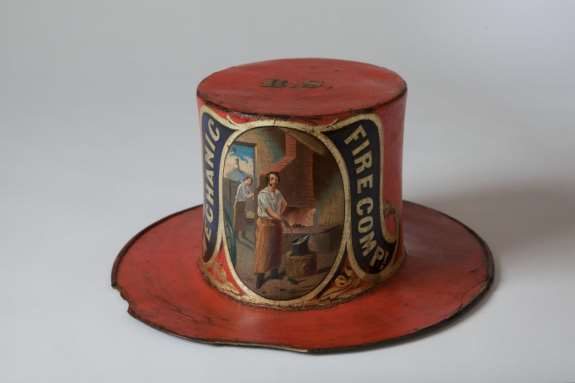
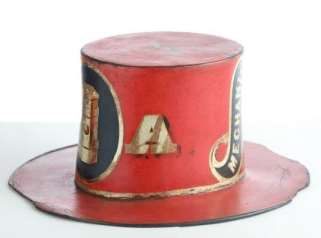
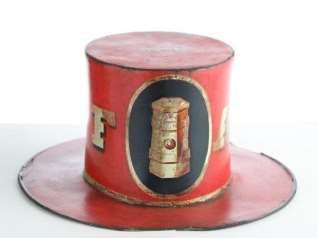
One of The Philadelphia Contributionship’s most remarkable items in its firefighting collection is the Mechanic Fire Company hat illustrated here. The Mechanic Fire Company chose as its logo an image of the famous blacksmith and fire engine manufacturer, Pat Lyon at the Forge, copied after the famous commissioned portrait John Neagle painted in 1826-27. This is a red stovepipe hat, made of pressed felt, painted and varnished, made by James Hill whose shop at the time was located at 207 Callowhill Street, Philadelphia. On the front of the hat above the portrait of Pat Lyon at the Forge is a banner with the name of the company: Mechanic Fire Company; At the top of the hat are the owners initials R.S. and on the back of the hat is the symbol of the Fire Association to which the Mechanic Fire Company belonged.
This hat tells different stories: that of the fire engine manufacturer and unjustly accused robber of the Bank of Pennsylvania, and the hat’s owner, R. Sparks, mortally wounded in the Battle of Gettysburg.
In 1798 Patrick Lyon was a well-established blacksmith working in Philadelphia having emigrated from Edinburgh Scotland in 1793 and working under the tutelage of Samuel Wheeler, a respected Philadelphia iron worker whose gates can still be seen at Christ Church, before setting up his own business. Lyon had previously learned the craft in London. Although he finished with formal education by age 11, he was interested in mathematics, philosophy and astronomy.
On July 4, 1795 Pat Lyon married Ann Brindley at Christ Church in Philadelphia and they had one child, a daughter Clementine; both mother and daughter died in the yellow fever epidemics of 1797. In 1798 the Bank of Pennsylvania foiled a robbery attempt but decided to move into leased space at Carpenters’ Hall for their operations. Samuel Robinson built the vaults and commissioned Pat Lyon to remove the doors and install new locks for them in early August 1798. Lyon advised against the locks the Bank’s directors wanted feeling they weren’t secure but did install them. Lyon then removed to Delaware as a new wave of yellow fever swept the city. On September 1, 1798, the Bank was robbed with the locks undamaged and suspicion fell on Lyon despite his absence from the city. He spent time in the Walnut Street Jail (shown in the background of the painting) without being formally charged. Ultimately it was proven that a local carpenter was responsible, and a grand jury found the charges against Lyon to be not sufficiently proven. He was released after four grueling months but found it hard to resume his smithing business and turned his focus to fire engines. This was a field in which he excelled providing engines for a number of local companies and the quarantine hospital in Tinicum.
By 1803 Lyon’s luck was improving. He remarried – this time his bride was Catherine Taggart and again the ceremony took place at Christ Church. In 1805 he won a suit against the Bank for “malicious prosecution and false imprisonment” and was awarded $12,000 in damages. His fire engine manufactory was flourishing and he began to acquire property. In 1825 he commissioned John Neagle to paint him at his forge, not as a gentleman but as a workman, a “mechanic.” The portrait, Pat Lyon at the Forge finished in 1826 was on view to the public and ultimately Lyon sold it to the Boston Athenaeum for $400. Neagle did a second copy at Lyon’s request which now hangs in the Pennsylvania Academy of the Fine Arts.* Lyon rescued his reputation and his story was well known to those of the day as he succeeded in elevating the position of the worker. Lyon died in 1829 but his memory lived on. The Mechanic Fire Company, established in 1839, chose this painting as its logo to be incorporated into its parade hats.
Members of fire companies traditionally provided their own hats purchased from the hatter of their choice. There are then subtle differences in the depictions of logos and the skills of the artists who painted them. In this case a paper label affixed to the inside of the crown identified the maker as James Hill, at 207 Callowhill Street. Hill worked from this location from 1857-1861 when he moved to 531 Callowhill Street. He is known for other equally elaborate hats including the Hibernia Fire Company hat that the Contributionship also owns.
In the upper righthand corner of this painting are the initials R.B., possibly those of the artist. There is a Robert Barclay painter listed in the 1858 city directory at 705 Little Pine and a Robert Black painter living in Richmond above Emory.
On the inside of the brim, written on the inside of the brim in green marker: R. Sparks Killed at Battle of Gettysburg and other illegible words. Written in pencil at top of crown "72nd Reg... Robert Sparks member of Mechanic Fire Co No 26 / Killed at Battle of Gettysburg July 2nd 1863".
There was no Robert Sparks living in Philadelphia in the 1850s and 1860s but there was a Richard Sparks, a willow worker, who lived at 1441 Ridge Avenue according to the 1861 Philadelphia City Directory and at 1417 Brown (practically next door to the Mechanic Fire Company) in 1862 although by then Richard George Sparks had enlisted in the 72nd Pennsylvania Infantry, more commonly known as the Philadelphia Fire Zouave Regiment. Sparks joined on August 10, 1861 for a three-year stint but was mortally wounded at the Battle of Gettysburg on July 3, 1863 according to the muster rolls of the Regiment. His rank at the time of death was Sergeant. His widow Catherine applied for his pension (her application notes he was wounded at the Battle of Gettysburg but died on July 6); they had three children. Despite the wording on the hat, it is most likely that Richard was the owner. The Battle of Gettysburg was a bloody one: 192 men were killed, 10 officers and 182 enlisted men. The regiment erected a memorial in their honor on the battlefield.
*For more information on Pat Lyon’s history and his portrait see: https://www.mountvernon.org/library/digitalhistory/digital-encyclopedia/article/patrick-lyon-1769-1829/
(Special thanks to Lee Ryan for help with genealogical research)
Curator and Archivist for the Philadelphia Contributionship