United Firemen’s Insurance Company of Nashville Fire Mark: The Good & the Bad
How to distinguish genuine Bulau 429 fire marks from fakes by their scrolls, paint, sprue marks and weight, based on Smithsonian and NYC Fire Museum examples.
By Bill Evenden
In The Signevierist, Issue No. 2011-3, Bob Shea wrote about the information he uncovered in his research on the company which issued the fire mark shown in Footprints of Assurance as No. 429. Bob found that Bulau was mistaken when he assigned this fire mark to the Union Fire Insurance Company of Nashville, Tennessee, founded in 1871. His excellent analysis showed that Bulau No. 429 must have been issued by the United Firemen’s Insurance Company of Nashville, founded in 1852, winding up ca.1856. But what can we say about the fire mark?
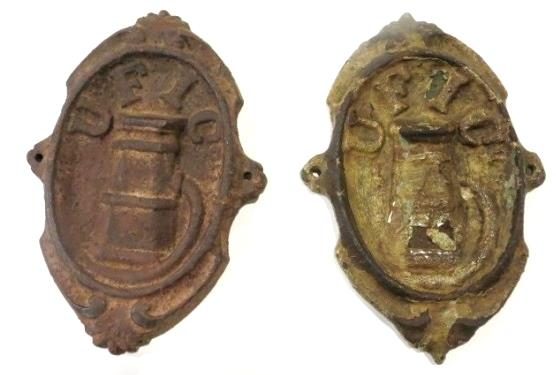
We know from experience that a company that was only in business for a short time, in this case approximately 4 years, would not likely have issued more than one type (variant) of fire mark, and that they would not have had time to issue very many of them. This accounts for Bulau 429 being a very rare fire mark. Unfortunately there are many fakes or untrue reproductions on the market. Al Wills illustrated the two common ones on page 6 of his 2003 article titled “Fire Mark Reproductions” contained in the FMCA Primer. The first one is a relatively modern one of larger size and smaller letters – obviously very different from the original. For the second one he says: “The other looks good except that it does not have a 2 1/4” diagonal sprue mark at 5 o’clock”. However, what he fails to point out are that the fan shaped scrolls at the top and bottom are much different than the sharp pointed top and bottom scrolls on the genuine mark. The pointed scrolls are clearly visible in the Footprints of Assurance photo of No. 429 on page 104. For clarification, I have always considered a reproduction as a facsimile of the original, whereas a fake has some details or features which are not like the original; in this case the wrong scrolls.
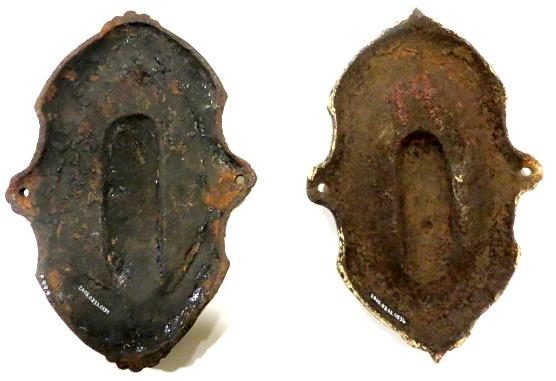
A side by side comparison of one of these fakes with an original is shown in Figure 1, and the reverse sides are shown in Figure 2.
These marks belong to the Smithsonian Institution and were previously owned by INA. The sprue mark Al mentions in his article is visible on the fake mark in the left side of Figure 2. I have seen many of these over the years, some having been offered by antique dealers, but most have been in museums, FMCA sales, on eBay or other auctions. Some have this sprue mark and others do not. For some unknown reason Al assumed if it has a sprue mark at 5 o’clock on the reverse side it is genuine, and if not it was a reproduction. It is of course possible that the ones without a sprue mark were made by someone who copied one with a sprue mark. That would indeed make them a reproduction, but of a fake. On a visit to his home late in his life, I noticed he had one of these on the wall in his collection, so I asked him why he had never published the fact that this mark is not like the original because of the difference in the scrolls. While not answering, he conceded that I was probably right about it not being genuine.
Another important observation is that neither I nor any other collector I have spoken to has ever seen one of these fake marks with old house paint on them. They are either rusty or they have modern paint colors on them. I researched the 5 marks listed on the NYC Fire Museum’s website and 5 that used to belong to INA, two of which are shown here in Figures 1 & 2, and 3 others which Smithsonian sold at Pook & Pook Auctions in Nov., 2010. One of the 5 at the NYC Fire Museum is a fake with the wrong scrolls, and 4 appear to be genuine as they have the correct pointed scrolls. Two of these are covered with old house paint (one of these is the one shown in the book as Bulau 429) and two are rusty. Of the 5 Smithsonian marks, the only genuine one is that shown here, which can be seen is covered in flaking old house paint. The other 4 have fake scrolls, one of which is the rusty one shown here, and the 3 sold have various amounts of modern original red paint (see Pook & Pook catalog, Lots 25, 97 & 236). Years ago there was a fake one for sale in a Philadelphia Pine St. antique shop which was like new with all its modern colors.
It was also noted that the genuine marks all weigh close to 3 lbs. and the fake ones weigh approximately 5 lbs., including the one entered into the FMCA auction in 2011 and withdrawn as a fake. I should also note here that none of the genuine marks examined have visible sprue marks on the reverse side.
It is unfortunate that so many collectors have been misled to believe that these marks with fake scrolls and sprue marks on their reverse sides are genuine company issued fire marks.
Note: My thanks to Tim Winkle, Associate Curator, Division of Home and Community Life, National Museum of American History, Smithsonian Institution, for allowing me to photograph their marks.