
Firemen's Insurance Companies: Firemen's Insurance Company of New Orleans
How Isaac Newton Marks and the Firemen's Charitable Association kept the New Orleans volunteer fire department going and chartered the Firemen's Insurance Company in 1875.
By Bob Shea
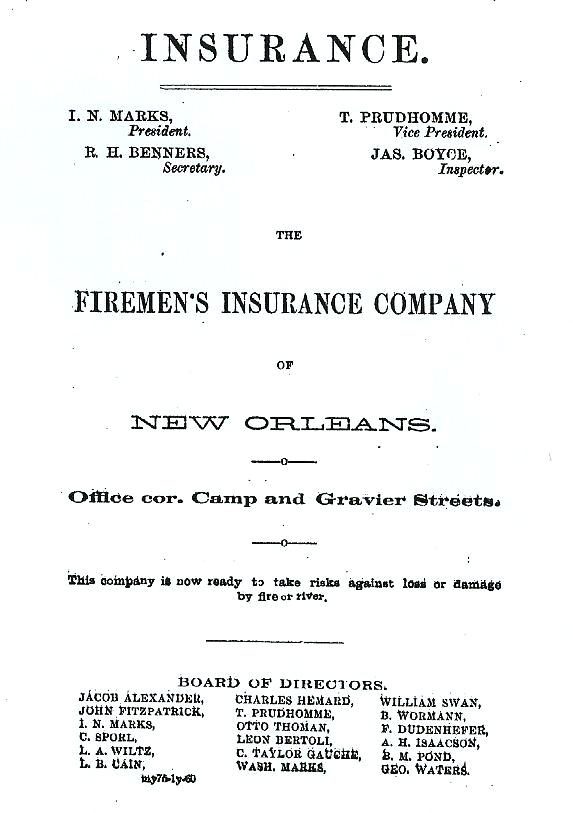
The New Orleans volunteer fire department was unique in America. In 1855 there were ongoing problems between the city of New Orleans and volunteer firemen. The city began to close fire houses, appoint their own Chief Engineer, neglect maintenance of apparatus and housing, give large appropriations to a steam fire engine company the firemen didn't want and to push for a paid department under a $85,000 contract with the insurance underwriters. The volunteer firemen reacted by disbanding their companies and returning their apparatus to the city, which the city had purchased for their use. At the same time, the Firemen's Charitable Association (FCA) elected Isaac Newton Marks as its president to deal with these problems. Organized in 1834 by the volunteers, the FCA was set up to give relief to firemen who were injured, old and in want, assist the families in sickness, and in death bury them and care for their widows and orphans. When the contract with the Underwriters came up for renewal in 1860, the Underwriters submitted a bid for $100,000 and the FCA, whose president was still Isaac Marks, submitted a low bit for $70,000 with the agreement to purchase the apparatus back from the city. The city agreed and the fire department operated under a contract system that was managed by the Firemen's Charitable Association, who chose the engineers and regulated all fire department matters, until 1891.
Marks again saved the volunteer fire department in 1862 when New Orleans was under the administration of General Benjamin F. Butler of the Union Army. Butler ordered that the fire department could retain their organization but that each member had to take an oath of allegiance to the United States as did all the citizens. While the average citizen could simply leave the city rather than abandon the southern cause, the fireman were in a difficult bind. Leaving the city would perhaps subject the city to ineffective firefighting and abandon their trust.
Isaac Marks proposed that the one thousand organized firemen receive permission to remain neutral and for that privilege they would continue to keep the city from burning. No one thought that Butler would go along. [As an aside, I remember visiting the Confederate Memorial Hall Museum in New Orleans and viewing a porcelain chamber pot with the image of Butler on the inside bottom. Needless to say, he was not liked by the civilians in New Orleans.] In addition, Marks had been a member of the Louisiana Secession Convention. Butler knew that he would have a difficult time to replace such a large and efficient group and with Marks' consistent assurances, Butler agreed. When it came to draw up the proposal or parole, the Army allowed Marks to write it, have it signed by the men and submit it. More that ninety-five percent of the firemen signed the following:
"We, the President, Directors, and Members of the Firemen's Charitable Association of New Orleans, do hereby give our parole of honor that we will well and faithfully perform our duty as firemen, as we have heretofore done in times of peace, and fulfill our contact faithfully with the City of New Orleans; and further, we give our parole of honor that we will not afford aid or comfort or furnish information to the enemies or opposers of the United States."
Isaac Marks was the founding president of the Firemen's Insurance Company of New Orleans that was chartered on February 25, 1875. Its charter is a most unusual document on many levels and shows that Marks had the makings of a sound insurance officer. Some of the unique points are shown below:
- It is hand written on lined legal size paper. There is no printed copy of the charter.
- The President, Vice President, also ex officio members of the board, and the other sixteen members of the Board of Directors were already installed. The officers and directors were to serve for almost one year, when there would be elections.
- Twelve of the sixteen directors were required to be members of the Fireman's Charitable Association. Isaac N. Marks, president of the insurance company, was also the president of the FCA and had been since 1855. Marks served as the elected President of the FCA for 32 years, until 1891, when the New Orleans fire department became paid.
- Public notice of elections were made by advertisements in English, French and German.
- Article One describes the corporate seal as, "… an impress seal , circular in form, which shall have for its device; "Buildings in the back ground, in flames, a Ladder resting against the front of the main building, with hose leading up the same; a Fireman, in the fore-ground, holding a Pipe, with a Steam Engine, Hand Engine, hose-carriage and a section of a Truck arranged around him as in service." Encircling said device, shall be inscribed the word "The Firemen's Insurance Company of New Orleans," and inside said inscription shall be the words "Incorporated February 25th 1875.""
- The last eight pages of the charter contained the names of fire companies and individuals and the amount of stock each purchased; over 2,000 shares were subscribed to. The FCA purchased 500 shares at $50 each out of 6,000, a year later amended to 3,000, and each of the directors were required to own ten shares. This meant that the Board of Directors, through the FCA, controlled a significant portion of the stock since one share was entitled to one vote.
While the rest of the charter is fairly straight forward, also notable is the amount of detail specifying how the business is to be operated and the careful listing of how various funds were to be set up to handle premiums and profits.
Stock
- The capital stock was set at $300,000 with 6,000 shares at $50 each. Ten percent or $5 was paid for each share at subscription with a promissory note for the remaining 90%. Dividends on profits would be used to credit the promissory notes. Subscribers who paid the full amount in cash would receive interest. [On February 20, 1876 the capital stock was amended to $150,000 with 3,000 shares]
Business would begin as soon as $100,000 capital (2,000 shares) was subscribed.
- Capital would not be used to pay losses or expenses. Should capital be reduced, then no dividend would be paid until such capital had been made good.
- Unless fully paid up, stock would be transferred only if the new owner assumed the obligations of the original purchaser with the approval of the President.
Directors
- The President and Vice President, except for the purposes of organization, would be elected by the Board of Directors [Note that twelve of the eighteen directors had to be members of the Firemen's Charitable Association of which Isaac Marks was the president.]
Miscellaneous
- Although authorized to write all kinds of insurance on Maritime, Inland and Transportation risks, business for the first year would "...be confined to Insurance against Loss or Damage by Fire only." [This restriction was soon eliminated by Amendment on May 25, 1875.]
- The company would invest in mortgages within the parish of Orleans if the real estate is worth, at least, double the amount of the loan.
- While the company would invest in stocks and bonds, there was no authority to discount negotiable paper, any banking business or trade in buying or selling goods.
- Dividends were paid from a Reserve Fund that consisted of interest received, profits on loans and investments or sources other than from premiums.
- A 10% interest dividend for paid up subscribers would be made twice a year from the Reserve Fund. If the fund was not sufficient, the deficiency would be made from net profits of the business, if the Directors approved.
- The net annual profits would be distributed as follows:
- 5% to the Reserve Fund
- 10% the Firemen's Charitable Association
- An additional 10% to the Reserve Fund to cover the interest dividend
- "The remaining net profits shall be divided among and paid to the participating Insurer of the said Company." [The Editor is not quite sure what this means.]
Isaac Marks remained the president for most of the company's existence until it retired in 1899 and reinsured in the Germania Insurance Company, New Orleans. The company wrote exclusively in Louisiana, had no agents, and, although the most premium they wrote was $177,271 in 1882, they were very profitable. The New Orleans and the New South, Compiled and Edited by Andrew Morrison for the L. Graham & Son, New Orleans, 1888, p. 56, writes that Firemen's declared, "... its usual dividend of 15 per cent. per annum [This amounted to over $20,000 in dividends per year.], amounting now altogether from the beginning to 180 per cent. The stock of this company has a par value of $50 and is quoted on 'Change at $65."
Isaac Marks was president of the Firemen's Charitable Association, the Board of [Fire] Commissioners of the New Orleans Fire Department, and the Firemen's Insurance Company, simultaneously and served without pay. Just like the other organizations, Isaac Marks accomplished what he set out to do when he wrote the charter of Firemen's Insurance Company. It seems that a number of insurance underwriters of the time could have used his guiding hand.