
Bulau 429
Bob Shea argues that the hydrant mark Bulau 429 belongs to the United Firemen's Insurance Company of Nashville (1852 – ca 1856), not the Union Fire Insurance Company.
By Bob Shea
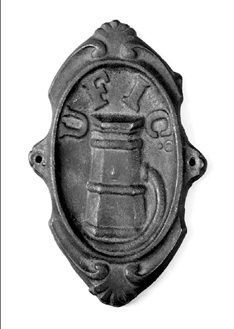
“This is the only mark in the entire collection whose identity is somewhat doubtful.”
The above quote is from The Insurance Company of North America Collection: American Fire Marks, 1933, page 116. Even though the INA “somewhat doubtfully attributed” the mark to the Union Fire Insurance Company, 1871, Nashville, Tennessee, Kenneth Dunshee in his Engine!~Engine!, published in 1938, page 41, had no trouble attributing the mark to the Union Fire Insurance Company. Dunshee added the additional information that the company ceased business prior to 1873. The same attribution and dates are in Footprints of Assurance, published in 1955.
One might ask, why was INA doubtful? They had good reason to doubt its identity because the name of the company was the Union Insurance Company; there was no “Fire” in its name. This information is found in the Acts of the State of Tennessee Passed by the First Session of the Thirty-Sixth Assembly for the year 1869-1870. Nashville: Jones, Purvis &Co., 1870, Chapter LXVII, Sections 30-43, pp. 471-474. The company was authorized to “insure against loss or damage by fire, lightning, wind, or tornado, or any other insurance whatever, that the Directors deem proper, including life and accident insurance…” While the Home Office was Nashville, Tennessee, the company may “be moved to any other town or place in the State.”
Having established that there was a Union Insurance Company organized in 1870, in Nashville, why does the mark attributed to the company has the initials “U F I Co.”? Where did the “F,” presumably referring to “Fire,” come from? The obvious answer is that the “F” represents the type of insurance the company wrote. If that is the case, then this mark is the only mark I have seen where the type of insurance is designated even though it is not in the actual name of the company. The usual practice is not to show the type of insurance on the mark itself. The number of company marks that show “F,” “Fire,” “F & M,” or “Fire and Marine” is very small out of the hundreds of different marks. Listing the type of insurance was redundant. Anyone would know that the mark on a building was for fire insurance. Besides, the company was chartered to “insure against loss or damage by fire, lightning, wind, tornado, or any other insurance whatever, that the Directors deem proper, including life and accidental insurance…”
There is another problem identifying the company. There is no record of a Union Insurance Company writing insurance in Nashville. After searching online and finding nothing, I contacted John Eubank, a fellow FMCA member, who lives in Nashville, and asked for his assistance. John went to the Nashville Public Library and reviewed the Nashville City Directories for 1870 to 1875 and found no reference to the company. There also was no reference to the men who were the recorded charter organizers of the company. John also visited the Nashville Archives and found nothing. After checking the business sections of the period newspapers and finding nothing, John concluded that if the company operated in Nashville, it was small or it never got off the ground. It may have even operated in another city.
Having determined that the mark is wrongly attributed to the Union Fire Insurance Company, the problem was to determine whose mark it was. While at the New York City Fire Museum, which has the entire fire mark collection of the Home Insurance, I had a chance to examine all five specimens of this mark. During the examination it was pointed out to me that one specimen had a paper tag glued to the back with the notation “United Firemen’s Insurance Company, Nashville.” At first I didn’t believe the label because that was the name of a Philadelphia insurer that issued fire marks that depicts a Reany, Neafie and Company steam fire engine and not a hydrant. I had second thoughts when I came home and decided to Google “United Firemen’s Insurance Company of Nashville.” BINGO! You can imagine my surprise when a got a few hits. The initials “U F I Co” on the mark fits the company’s name.
From the Acts of the State of Tennessee Passed at the First Session of the Twenty-Ninth General Assembly for the Years 1851-52. Nashville: Bang & McKennie, 1952, Chapter CLVI, pages 225-232, I found that the company was incorporated February 25, 1852 and that it was organized by the officers and members of the four volunteer fire companies in Nashville under the name “United Firemen’s Insurance Company of Nashville.” The emblem of a fire hydrant certainly fits for a firemen’s insurance company.
The incorporating charter had a preamble, which I have only seen in one other firemen’s insurance company, the Fire Association of Philadelphia. Both charters start with the word “Whereas” and recite the reason to organize themselves into an “association” to “enable them more effectively to perform” “those philanthropic duties” (Fire Association); “those duties imposed upon them as members of fire companies” (United Firemen’s). While this may appear mere legalese formula, I think it shows that the United Firemen’s used the Fire Association as a model, even emulated it. While not an actual association like the Fire Association, their preamble states that the fire companies “have formed themselves into an association under the name of the United Fireman’s (sic) Insurance Company of Nashville.” The word “association” used throughout the United Firemen’s charter refers to some larger organization or purpose rather than the insurance company itself. It therefore isn’t a coincidence that the United Firemen’s used a hydrant as a symbol. The Fire Association’s symbol was a hydrant and theirs would be also.
Returning to the Nashville City Directories I was able to find references to the company only for the years 1853/54 and 1855/56 with no listing thereafter. The first reference has a small ad that lists A. W. Johnson as president and J. S. Dashiell as secretary. The second listing has no ad and only lists the company alphabetically. The company’s name is misspelled “Fireman’s.” John S. Dashiell is listed alphabetically as secretary to the, again, misspelled company. There is no listing for A. W. Johnson. Finding no other reference to the company I surmised the company withdrew. It seems that the new company may have had problems with either raising the capital stock or fire department management or both. Its charter was amended twice diminishing fire company ownership and control and disappeared.
At this point I, again, turned to John Eubank for assistance. After explaining what I found, I asked John if he would check the same sources for any information of the United Firemen’s Insurance Company from 1852 to 1860 with particular emphasis on finding archive material of the company such as a policy, stationary or stock certificate that might show the hydrant. Again John drew a blank.
It would be nice to find a direct connection of the fire mark to the company, a smoking gun, if you will. However, the fact that the “Union Insurance Company of Nashville” did not have “Fire” in its name; that there was a “United Firemen’s Insurance Company of Nashville” whose initials are “UFICo” and the hydrant is a symbol of the Fire Association, which the company emulated, leads to the conclusion that the fire mark was issued by the “United Firemen’s Insurance Company.” I’m hoping that someone will find the direct connection in the future.
In the mean time, I’m changing the attribution in Bulau to:
United Firemen’s Insurance Company
Nashville, Tennessee
1852 – ca 1856