
The ABCs of American Fire Marks: H Is for the Home Insurance Company, Columbus, Ohio
History of the Home Insurance Company of Columbus, Ohio (Bulau 344-346 & 346X1), from its Xenia Mutual origins to its insolvency and dissolution.
By The Old Underwriter
H is for the Home Insurance Company, Columbus, Ohio
Bulau 344-346 & 346X1
Originally organized on March 20, 1851 as the Xenia Mutual Insurance Company of Xenia, Ohio, the company moved to Cincinnati in 1856 and later to Columbus on December 24, 1863. No doubt a group of investors acquired the charter sometime in 1863, which is the year of organization advertised by the company and began to convert the company to a stock insurer. It wasn’t until April 26, 1864 that the name changed to the Home Insurance Company.
From the start, two names of the organizers, are particularly notable: Lewis W. Cass, director and vice president, and D. B. Hubbard, director and secretary. Both these gentlemen were connected with the Illinois Central Insurance Company of Decatur, Illinois and the State Insurance Company of Hannibal, Missouri, both of which failed. They were in fact organizers of wild cat insurers. It was no coincidence that they converted Xenia Mutual to a stock insurer; both the Illinois Central and State were originally mutual companies.
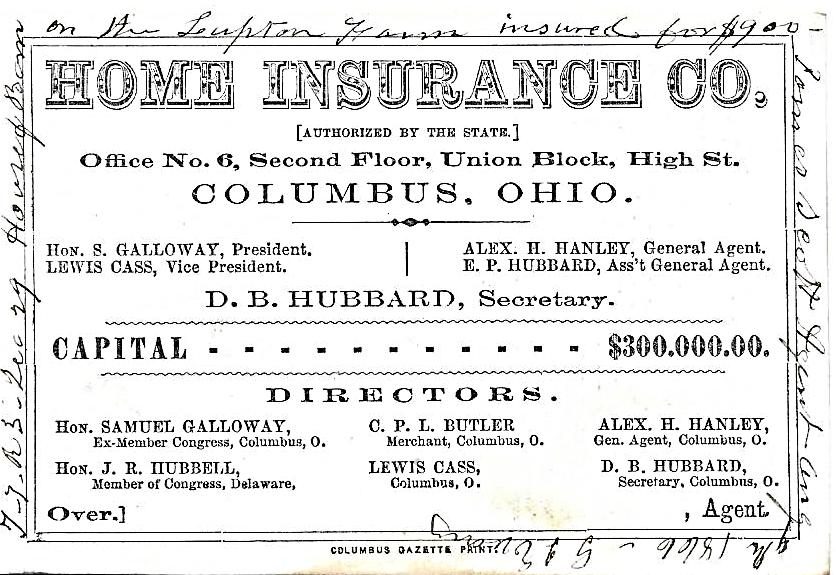
In the company’s early newspaper advertising from 1864 to 1867 in Ohio the company does not list its capital. However, for the same period in West Virginia the company lists its capital as $300,000. The 1866 trade card below also lists the capital as $300,000.
A November 1867 ad lists the capital and assets as $545,618.28. The Home’s filed financial statement to the Ohio Insurance Department as of December 31, 1867 lists the paid capital as $100,000 and assets as $466,514.27. Overstating its capital or lumping capital and assets and calling it cash assets is something the Home did over the years. Something was going on here.
The company did not add additional capital when it converted from a mutual to a stock company. They concealed their liabilities and capitalized the assets, which consisted of premium notes from the mutual. They listed the premium notes as both assets and capital in early annual reports to the insurance department. Also, the fact that the Home of Columbus was able to operate in multiple states, including New York, until 1882 demonstrates the loose regulation of insurance at the time. But that’s another story. It took a comprehensive audit by Ohio’s Superintendent of Insurance, Charles H. Moore, to find numerous examples of overstated and fictitious assets and eventually a confession by the company’s president, J. B. Hall, to reveal the extent of the company’s deceit and years long insolvency.
With its extensive use of testimonials for claims payments in local newspapers the company grew with nearly 1,700 agencies. As confessed by the president in 1882,
The entire history of the company, in the most charitable sense, has been the intention to do right toward its patrons, and an abiding faith that eventually everything would come out right…Had the profits of the business continued, our experience of 1873, 1874, 1875, and 1876, we would have succeeded; but the adversities of later years has tested the actual strength of the company…
Sixteenth Annual Report of the Superintendent of Insurance of the State of Ohio 1883. Part 1.- Insurance Other Than Life, p. lii
Having paid out $150,000 in dividends to its stockholders and operating with a relatively high expense ratio, due to high commissions and executive salaries, the Home Insurance Company was insolvent. The Home was dissolved, and the remaining assets placed in the hands of a receiver.
After years of false swearing and perjury the executive officers were not indicted by a grand jury. After all, its president, Mr. Hall, was a member of the state legislature.