
The Back Is Beautiful
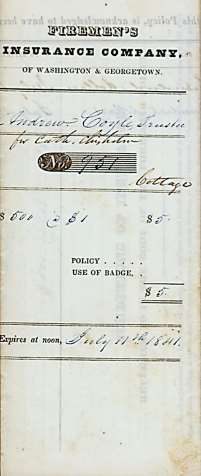
The back of a Firemen’s Insurance Company of Washington & Georgetown policy shows how the use of the company’s fire mark, or badge, was recorded and charged.
By Bob Shea
“The back is beautiful,” is an expression used by Al Wills to indicate that you can learn a lot about a fire mark by studying the back. For example, you might see a manufacturer’s casting mark, soft red rust or unusual rubbings to indicate a reproduction. Also, the back may contain a sprue mark, tab or clearly defined hollowed out areas indicating a possible authentic mark.
Did you also know that a lot can be learned about the use of fire marks from the back of an insurance policy? Consider the back of the Firemen’s Insurance Company of Washington & Georgetown’s (Bulau 139) policy pictured below:
This early preprinted one year policy has the notation “use of badge,” [Note that the early American fire insurers referred to fire marks as “badges.”] Because there is no charge shown, it’s clear that the use of the company’s fire mark, Bulau 159, was optional for the insured. Al Wills’ article in the FMCA Newsletter, 1 – 1990, p. 4, states that the annual fee for the mark was 25 cents. While 25 cents may not be a great deal of money, in this case it was 5% of the $5.00 premium. Note that the $5.00 premium for $500.00 coverage meant that the insurance rate was only 1%, or $1, per hundred. Viewed from a percentage standpoint, in this instance, the charge for the use of the fire mark seems high.
If you are ever looking over an old fire insurance policy, especially one by a company that issued a cast iron fire mark, be sure to check the back to see if there was a change for the fire mark.