
Bulau 275
A comparison of examples of Bulau 275, Citizens' Fire, Marine and Life Insurance Company of Wheeling, finds lettering and design details on one New York City Fire Museum mark.
By Bob Shea
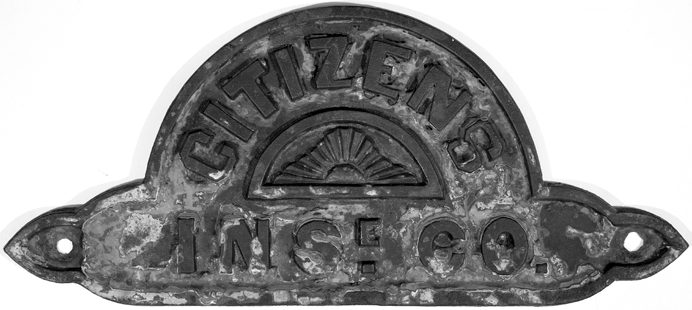
While on a recent visit to the New York City Fire Museum (NYCFM) I had a chance to examine three examples of Bulau’s 275, Citizens’ Fire, Marine and Life Insurance Company of Wheeling, West Virginia. I laid all three side by side and, at first, they looked the same. However, I noticed that one of the marks, 00.3640, which is illustrated in Footprints of Assurance and shown above, looked ever so slightly different. The mark had much more detail. What seems to be an apostrophe after the “INS” is not an “apostrophe” but is actually the letter “E.” Also, the periods below the “E” and after “CO” were not round but square. In addition, the fan design in the center of the mark is clearly seen as the sun with its rays.
The details of the “E” and square used as a period were not seen on the two other examples of the NYCFM’s 00.3976 and 00.3977. The lack of details is also seen on the mark of the Smithsonian Institute’s 2005.0233.0548, which is the same mark shown in INA’s publication American Fire Marks, page 124. Even the B.275 recently sold on eBay did not have this detail.
When I got home, I wondered why there was an “E” after “INS.” I decided to search Google for “inse.” Finding nothing, I went to Googlebooks and entered both “inse” and “insurance” in quotes. After searching a number of sites, I found that insurance sometimes was abbreviated both as “ins” and “inse” in English and Irish insurance/legal publications in the late 1800s. This only added to the oddity of this mark. Why would a West Virginia insurance company, whose dates are 1856 – 1877, use the English/Irish abbreviation of insurance on their fire mark?
While not going so far as to say one or the other was a variant, you may want to footnote this article in your copy of “Footprints.” Certainly, Bulau’s 275 must be considered the “gold standard” of this mark.
Photo courtesy of the New York City Fire Museum, H. V. Smith Museum (Home Insurance Co. Collection)