New Discoveries
A State Mutual Insurance Company mark found in a real photo postcard, plus new variants of Virginia Fire & Marine, Fire Association and Niagara Fire marks.
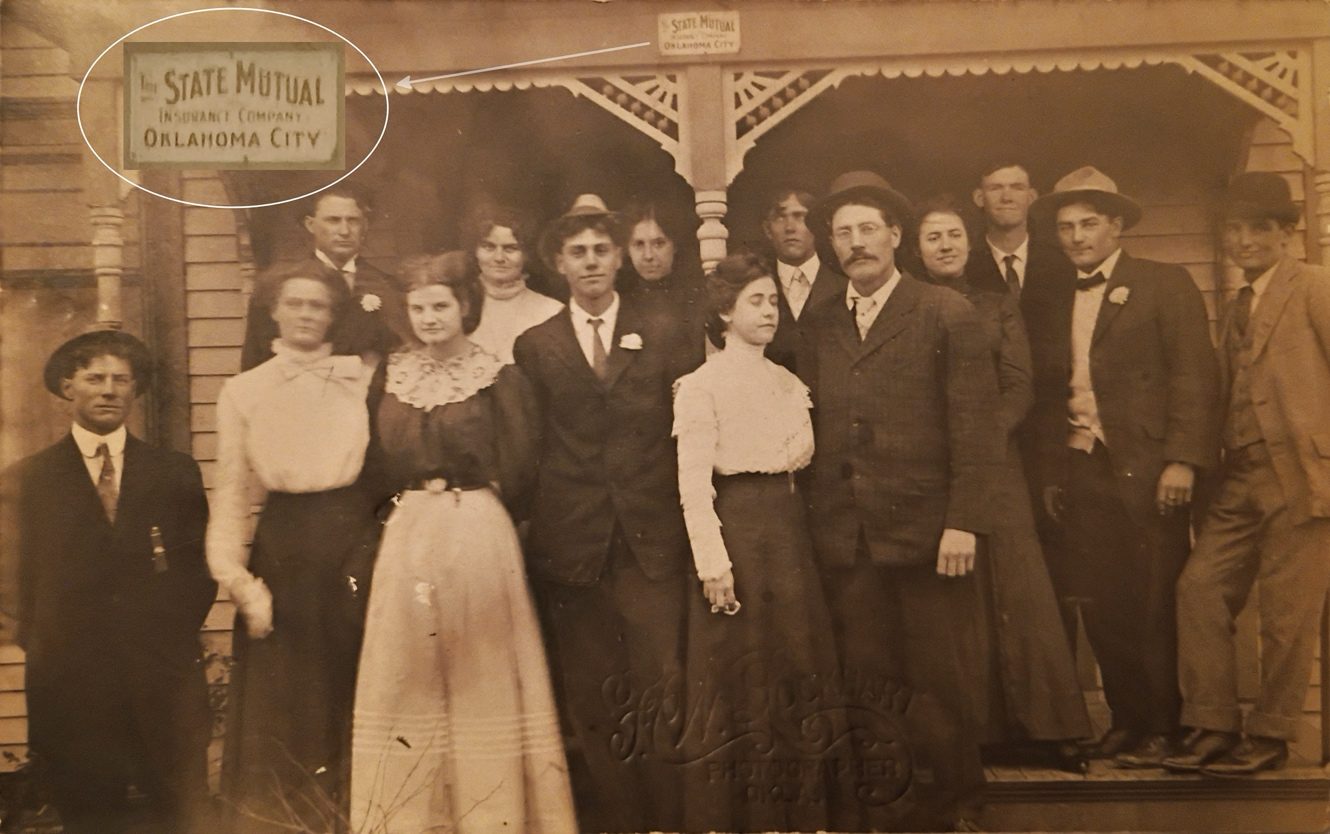
The new year has started off with a bang for FMCA as there are many new fire marks that have been discovered and each will be presented in this newsletter. The most exciting is one that was discovered by member Logan Smith. Pictured above is a Real Photo Postcard (RPPC) that Logan discovered. As you can see, the photo shows a family posing on the porch of a house. At the very top center is a fire mark tacked to the house. This I believe is only the second photo discovered of a tin fire mark in situ. What is even more exciting is that the mark pictured is for an undiscovered mark from a company not known to have issued a fire mark. The mark was issued by the State Mutual Insurance Company, Oklahoma City, Oklahoma Territory. As per Bob Shea the company dates are 1899-1916 at which time the company retired and was liquidated. The mark itself dates 1904-1916 as the company moved from Medford, Oklahoma Territory to Oklahoma City, Oklahoma Territory in 1904. Newspapers of the period do not indicate why they retired. It was a small mutual with less than $60,000 in assets of which most were in notes. They had a lot of bad press as a result of basically losing a defamation suit against a newspaper. The company won the case but only got $100 in damages, when they asked for $10,000. The case dragged on for three years. The officers' salaries were also questioned, and it probably wasn't worth the aggravation to stay in business.
The new mark will be classified as US-SG-1 in our addendum and will be attached electronically for anyone wishing to print it out for their records. It might be a good idea for members to search eBay for similar photos in hopes of finding other discoveries. I now have a search for “RPPC porch” set up in eBay in hopes of finding something like what Logan found. The next mark discovered below is a variant from a company already known to issue fire marks.
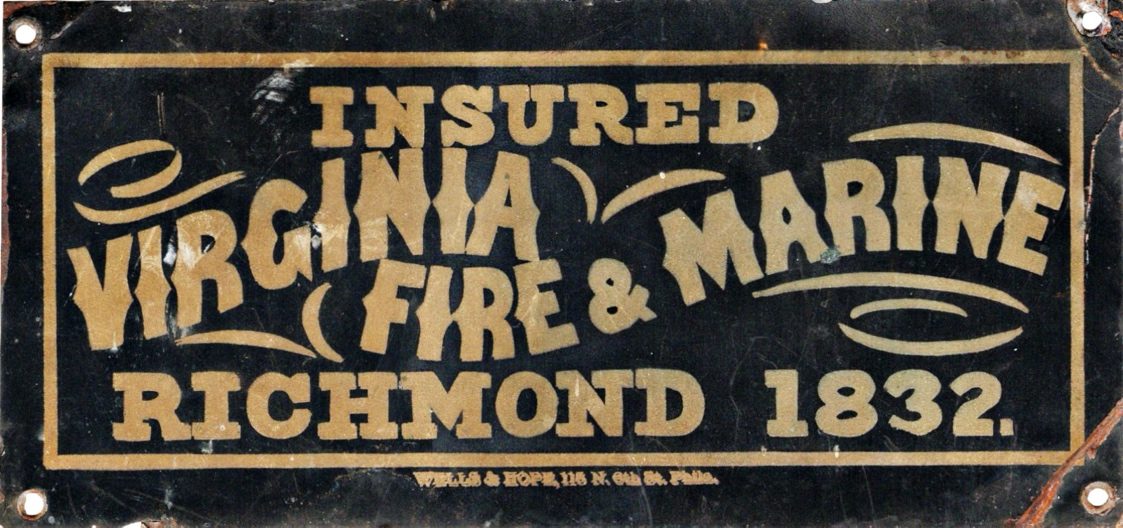
The mark pictured above is from the Virginia Fire & Marine Insurance Company, Richmond, Virginia. It is the fourth mark discovered from this company and will be listed as B.124-V-A. The other marks issued from this company are B.123, B.124, and B.123-V-A. The interesting thing about this mark is that at the bottom center is a maker’s mark from Wells & Hope, 115 N. 6th St. Phila. Signevierist issue 2022-2 featured an article “House Plate Manufacturers” for anyone interested in adding this mark to the list of fire marks with a maker’s mark.
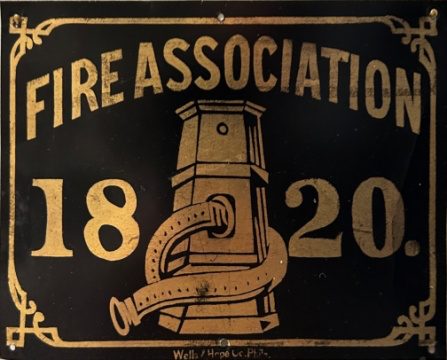
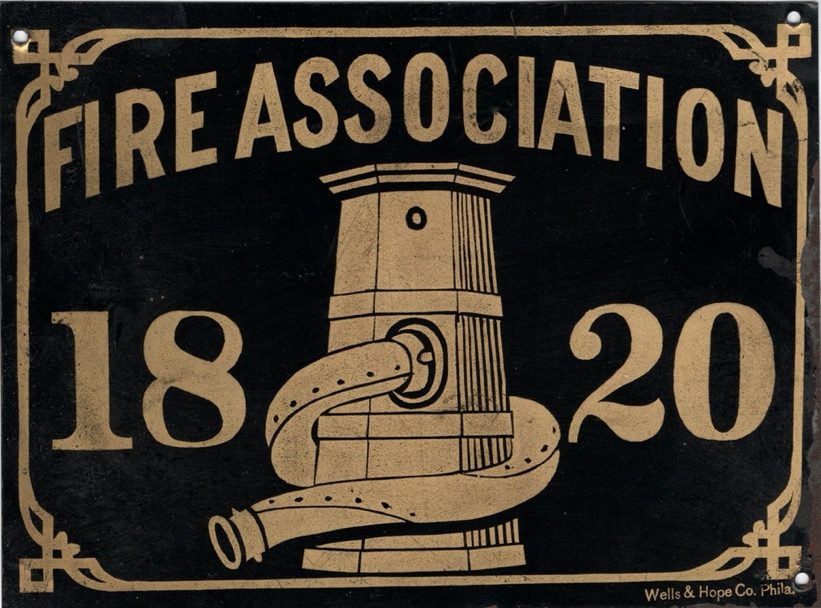
The next new marks show the importance of carefully looking at marks in your collection and comparing them to known documented marks. Not only is this a fun way to review your collection but it also may lead to new discoveries. The mark in question is what I thought was B.94-V-B from the Fire Association of Philadelphia. I obtained this mark from the late Bill Evenden in a trade for an American Exchange fire mark (US-AE-1) that I had discovered in December of 2016. Bill knew that my main focus of collecting marks was Philadelphia marks and figured since he had two of these tin marks it would be a good trade for both of us. It was a tough decision, but I figured I would never have another chance to get a B.94-V-B since they are rare and quite expensive, so I agreed. For many years the mark hung on my wall with my other FA’s without really thinking there was anything different than the one listed in the addendum. Early this year I had been looking through my addendum and stopped on this mark in particular. I happened to be looking at my mark hanging on the wall and noticed right away several key differences which I will outline below a side-by-side comparison of the marks pictured on the next page. I would like to thank members Tom Hardy and Bob Shea for helping get a colored photo for comparison to my mark. I also decided to remove my mark hanging up and document measurements just in case there were any variations.
B.94-V-B vs. B.94-V-C
Key Differences:
- Measurement differences: 7x5” vs. 6 11/16 x 4 13/16”
- Font of the numbers (best seen in the number “2”)
- Period after the date vs. lack of period after the date
- Details of the hydrant / hose – rivets of the hose, bands around hydrant, and shadowing on the right side of hydrant.
- Placement of the maker’s mark: bottom center vs. bottom right
While the differences are subtle there are quite a few so it was determined that the mark obtained from Bill Evenden would be classified as a new variant and labeled B.94-V-C.
The last discovery is another with subtle differences that require a side-by-side comparison.
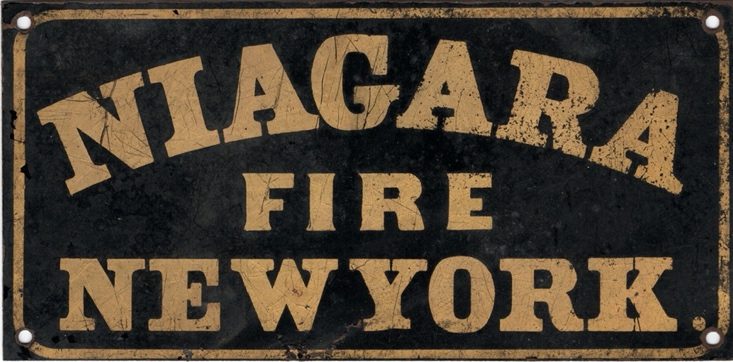
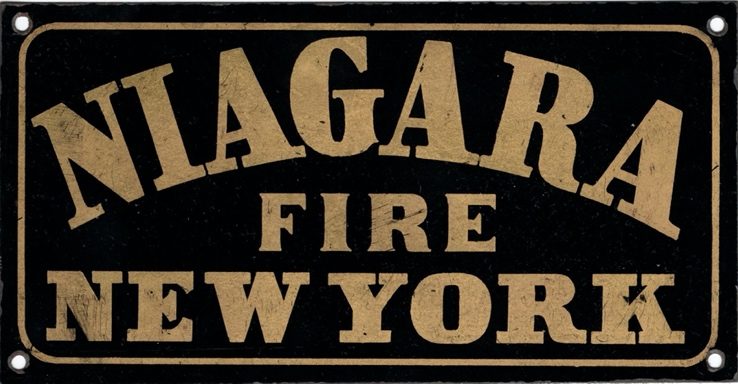
B.200 vs. B.200-V-A
I previously acquired B.200 from the Niagara Fire Insurance Company of New York on eBay and was lucky enough to obtain the mark on the right also from eBay earlier this year.
Key Differences:
- Measurement differences: 6 7/16 x 3 1/8” vs. 6 ½ x 3 ¼”
- Period after “New York” vs. lack of period after “New York”
- Font of lettering (best seen in the letter “A”)
- Letter size of “Niagara”: ¾” vs. 1”
Once again subtle differences but when shown side by side they are quite evident.