
Sharing an Old Email from Bill Evenden
A 2019 email from the late Bill Evenden recounting his 1979 search for German fire marks in Poland and the growth of fire mark collecting in Germany.
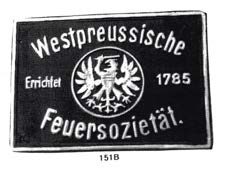
One of the main goals of the Fire Mark Circle is preserving the rich history of fire marks and fire insurance. One of the best ways to do this is documenting information passed down from members that have been in this organization much longer than I. Members that knew Bill may have remembered him from his thick exterior or his “My way or the highway” mentality. While this was true, he was also a fountain of information especially on collecting fire marks here in the states and abroad long before it became popular. His passion and information about German marks always impressed me so I made it my goal to find rare German marks and reach out to Bill not only to help him procure something he didn’t have but also to learn the history of these rare marks. I would search Germany’s eBay site high and low and when I found something of interest, I would email it to Bill and ask him to share his knowledge. Below is a picture of a mark I couldn’t identify until Bill told me it was in the supplement, so a mark that was discovered after he published his work. Below the picture is a lengthy email I received from Bill in 2019 that has a lot of history in it that I thought would appeal to our organization even though it isn’t about American marks.
Hi Michael,
Thank you for this. I almost lost it, but in the end, it worked out because there were no other bidders. I usually wait until the final half hour to bid, but because I forgot the end time was at 4:47 in the morning while I was happily asleep and did not set the alarm, it was over by the time I looked. This was partly due to too many things going on with maintenance on our house, which kept me distracted, and partly due to old age forgetfulness. Anyway, I immediately wrote to the seller that I wanted to buy it, and he responded that he reentered it as a Buy It Now at the same price he had set for the start of bidding before. So, I lucked out and bought it. It is in transit now from Poland. The seller seems like a friendly guy; very responsive to all my questions. I sent him a list of German marks that were used in Poland before the war when much of today’s Poland was part of Germany, so I am hoping that he will find others for me in the future. One never knows. It is a long shot because the Poles took down all street signs and any other signs in German right after WWII.
We took Lore’s mother with us in 1979 to see the houses and sawmill/engineering company property that belonged to the family in the city of Sorau, where Lore was born, which then was in the Prussian Province of Mark Brandenburg and east of the Oder-Neisse Line, which the Allies agreed to as the new border between Germany and Poland at the end of WWII. When we visited the churchyard cemetery where her grandfather was buried, all the gravestones had been destroyed and were piled up in the corner of the lot. One could just make out parts of German names on the broken pieces. That is a direct result of the hate the Poles had for the Germans when the war was over. It was a terrible time. Lore’s family lost everything, and she was lucky that her mother had the courage to round up all the family members and organized their company’s tractor with two trailers hooked up and driven by a Pole who worked for them. When they pulled out of their street Russian tanks were already on the next street, so they just made it.
We spent 5 days driving around Poland looking for fire marks, and the only ones we found were tin ones which had been painted over with house paint or were rusty so the German writing on them was almost unrecognizable. We visited a Polish guy in Opeln, Upper Silesia, who I had exchanged letters with previously, and he had obtained 2 enameled iron ones (124E & 124O in my book) for us from a flea market prior to our coming. He and a friend who spoke German spent a day driving around the countryside with us looking for marks. We only found one, which had been painted over, and they negotiated with the farmer to take it off his house for the price of a bottle of vodka. That was No.124A in my book. My main objective on that day was to drive to the city of Glatz near the Czech border to try to find a Glazer fire mark like Bulau No.1380. But no luck, for reasons stated above: all things written in German were removed. Painted over tin ones, or very rusty ones, were not removed because one could not read the German script on them, but it is easy to understand why the enameled iron ones in all their colorful luster would attract attention. The best marks we got on that trip were Nos. 108A and 108B, which you can see that we restored them. In this case, because the Province of Posen had become part of Poland after WWI, and the Germans were not driven out, like they were after WWII, many of the older people in that area spoke German, so I could communicate with them. I’ll interject here: that was the day we ate a bowl of soup and had a cup of tea for lunch in a community type restaurant that cost us the equivalent of 17 cents apiece! I always think about that when I think about finding those two rare marks that day.
The next day we were farther north in Scheidemuehl, and I got a Grenzmark tin mark off a house, which was very rusty, and because the details are not raised much, I could hardly read it, even up close. Years later after one of these in original colors was acquired by a collector friend of ours from a dealer, I used it to restore ours. His original one is shown in my book as No.45A. Shortly before the book was published, the enamel coated iron variant of this came to light and I was able to get it included in the supplement on page 139, as No. 45B. I knew then that after we had been in Schneidemuehl, we drove through a nearby village where we saw several of those tell-tale spots on buildings where these enamel Grenzmark fire marks had hung.
On our final day in Poland, we drove north to Stettin, because I wanted to try to find a Bulau No 1337, which would have been used only within the city. This is where reality hit home. Most of the buildings in the city center had not been renovated and one could clearly see the spots left on the front of them where a fire mark had once hung there. It was a big disappointment, and to this day only two of these marks are known, the one in Footprints, which is stored in the basement of the NY City Fire Museum and a slightly damaged one that showed up on German eBay years ago, and one of the German Club members managed to contact the seller as soon as he saw it and offered him enough money to get him to agree to withdraw it from the auction and he bought it, but I don’t know how much he paid. It was during the years when fire mark collecting in Germany hit its peak and many Germans went almost crazy paying ridiculous prices. Anyway, this Stettin mark has been at the top of my wish list for 50 years, but I don’t ever expect to get one. The Home got their mark by writing to the company before WWII and the company sent it to them free, just like most of the marks they had from all over the world.
The day we left Stettin, we drove across the border into East Germany. This was in the north, which was the Province of Pomerania (Pommern in German), and in the first village we came to we were rewarded with the discovery of No.107D, which is a much darker blue than the other variants in the book. The owner was a lonely widower who had a daughter living in West Germany, so he was happy to have visitors. He invited us in for a cup of tea, and during the discussion he revealed that besides the mark on his front gate, he had a second one in his shop, and he ended up giving us both of them.
When we drove to Poland for 5 days in 1979, there were no other known fire mark collectors in Germany, and we had already been collecting for 10 years, so the field was more or less wide open for us, and we took advantage of this in my spare time. However, after we found out about a few other collectors in 1983, we formed the club in 1984 just before I published my first paperback booklet on German fire marks. The widespread marketing of that book in the insurance industry in Germany did a lot to publicize the hobby, and within a few years we had 150 members. When word got out that these small signs were in demand, it caused the dealers to get involved. Prior to this, the closest thing on the market, which enjoyed a wide amount of interest, were the beer, cola, and other advertising signs that people had been collecting for years. The result of all this was that prices started to go through the roof, especially for ones that appeared to be rare. Dealers with contacts in East Germany and Poland started showing up with some of these German fire marks from those areas, and later eBay became a good source of fire marks. So, when I had the opportunity to acquire a Danziger Feuersozietaet No. 27B and a Glatzer No.62A that I could not find myself in Poland, I had to pay a dealer a lot of money for them. Now that market has also dried up.
Well, I have rambled on far more than I intended at the outset. Thanks again. We do hope to get to Washington in October.
Best wishes,
Bill
--If any members have interesting emails that they have had with members that have long since passed please forward them to the editor so that I may share them with the membership. --