The ABCs of American Fire Marks: Q Is for the Queen City Insurance Company
History of the Queen City Insurance Company of Cincinnati, Ohio, 1857–1870, issuer of Bulau 207, from its Brown County charter to its retirement.
By The Old Underwriter
Q is for the Queen City Insurance Company, Cincinnati, Ohio
1857 – 1870, Bulau 207
The Queen City Insurance Company was incorporated on March 20, 1851, as the Brown County Insurance Company. Its authorized capital stock was $50,000 at $25 a share, with the authority to issue up to $100,000. At subscription, one dollar had to be paid with the rest in notes. The business of fire and marine insurance could commence when five hundred dollars of stock, paid in or secured, was subscribed to.
It does not appear that the company actually commenced operations and the charter was, no doubt, sold to Cincinnati interests, who on May 1, 1857, filed to change the company’s name to the Queen City Insurance Company. The new owners fully subscribed to the $100,000 stock with $50,000 cash and $50,000 in notes.
Always a small company, the Queen City never seemed to find its balance. For example, there were at least six different presidents and five secretaries in its fourteen years of operation and its board of directors was constantly changing.
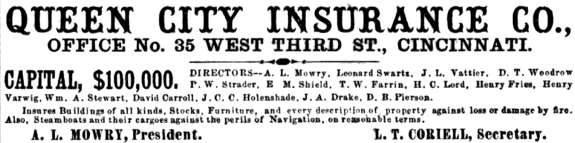
It is hard to determine its scope of operations or profitability as the company did not publish any financial information in its advertising. The ad shown below is a typical one that only shows its capital, of which only half was paid. An early ad in 1859, and used into the late 1860s, listed the company as the Queen City Fire and Marine Insurance Company. No doubt, referring to the types of insurance written, rather than its legal name. Also, they may not have used agents and wrote business directly.
It wasn’t until the First Annual Report of the Ohio Insurance Department of the Auditor of State’s Office, that I was able to review the company’s results for 1867. After ten years of business, its assets were just over $80,200, $50,000 of which were notes for capital. Its income was $21,800 with $36,600 expenses of which $25,700 were for losses. Clearly, this was a troubled company.
Results for 1868 were not much better. While its assets improved to $102,300, the largest portion consisted of $74,000 in notes for capital stock. Presumably, $24,000 of cash capital was replaced by notes. While losses were down, expenditures still outperformed income.
Results for the Queen City’s last full year of operation in 1869 showed assets of $91,000, which composed mostly of stock notes for $74,000. Again, expenditures outperformed income. Clearly, the company could not continue and in 1870 the Queen City Insurance Company of Cincinnati retired.
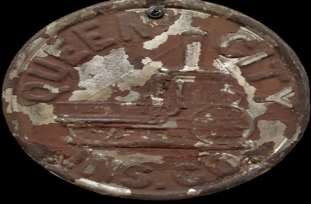
Its wonderful round fire mark with the “Uncle Joe Ross” steam fire engine is all that remains.