
American “House Plates” / “Fire Marks”
Bob Shea traces how American insurers used the term “house plate” in the 1800s and when “fire mark” came into general use.
By Bob Shea
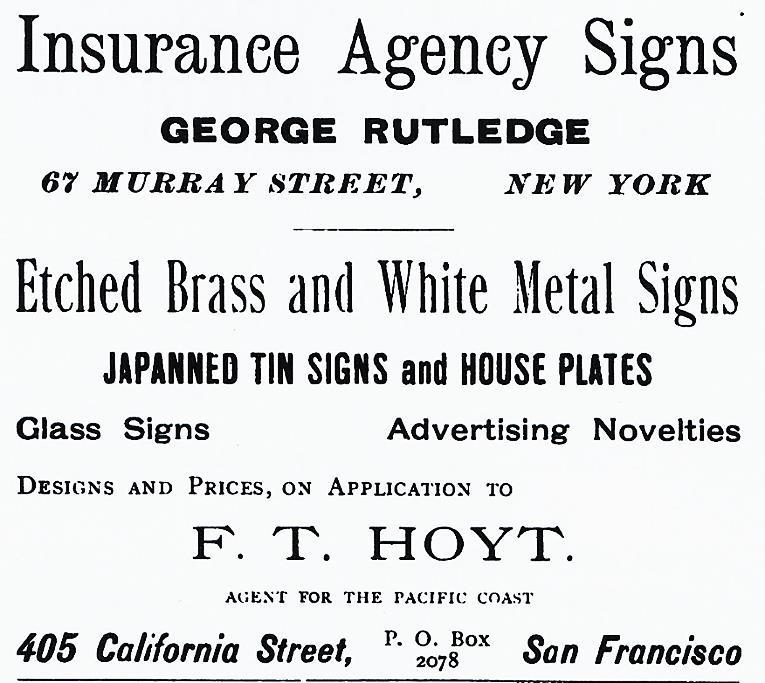
The above advertisement for George Rutledge in the 1890 Pacific Coast Insurance Directory got me thinking. How is it that as late as 1890 a well-known New York sign manufacturer referred to what we today call a fire mark as a “house plate?”
A survey on Google and Google Books reveals that American insurance companies, the insurance press and insurance sign manufacturers did not use the term “fire mark” in the 1800s. The term almost exclusively used was “house plate.” No doubt “plate” is short for “tinplate.” While early British writers also used the term “plate” or “insurance plate” to refer to a fire mark, it was the Americans who used the term “house plate.”
A review of prior issues of The Signevierist shows that the Aetna, Andes, German of Freeport and Phoenix of Hartford issued instructions to their agents to attach “house plates” to insured properties. Even the frequently referred to “Tiffany’s Instruction Book, for Fire Insurance Agents” used “house plate.” Prior Signevierist issues also show two other insurance sign manufacturers who made “house plates.”
A review of the insurance press shows that “house mark” and “insurance plate” were also used, though not as often as “house plate.” In fact, “house mark” was used by the Insurance Company of North America as late as 1920 in their advertising and in the 1929 One Hundred Years printed by The Franklin Fire Insurance Company of Philadelphia.
I did the following searches on Google and Google Books to match up the following words with an insurance company:
- “expenditures” and “fire mark”: no hits
- “expenditures” and “door plates”: four companies with six hits
- “expenditures” and “house plates”: twelve companies with eighteen hits
It’s only in the twentieth century, when three early Philadelphia fire mark collectors published, did the term “fire mark” come into use. The earliest American use of the term “fire mark” I found is George Cuthbert Gillespie’s Early Fire Protection, Fire Insurance Companies and the Use of Fire Marks, which was printed in 1905. Harold E. Gillingham followed in 1914 with Fire-Marks of American Fire Insurance Companies, and George Cuthbert Gillespie and Stevenson Hockley Walsh in 1915 with Fire Insurance House Marks of the United States. The latter publication used both house mark and fire mark interchangeably.
It isn’t until the 1929 publication of American Fire Marks by the Insurance Company of North America that “fire mark” became the insurance industry-wide phrase to describe both British and American marks.
Future issues of The Signevierist will cover how the idea of house plates shapes the discussion of American fire marks and their definition.